5 Tips For Cultivating an Adventurous Spirit

Montessori Thrive • August 20, 2020

There are times in our lives when caution and hesitation serve us well. After all, self-preservation is critical to living a long and happy life. But finding ways to incorporate adventure into even the most mundane of routines sparks something special in the human spirit. Adventure shows us the magic of our world and gives us a peek at what might be possible. Cultivating adventure in our children gives them a chance to see what they are really made of while delighting in new places and experiences.

As a bonus, novel experiences are neurologically healthy. Modern theories about brain development focus on neuroplasticity, which is connected to repetition and neural pathways. The more we do something, the more those particular pathways are strengthened, so the more we share adventure with our children, the more that will become a part of who they are.


Be Spontaneous

Routine and structure are really important for children, but so is a sense of flexibility. Plus, spontaneity can be just plain fun! There are hundreds of ways to go about this one, but here are just a handful of ideas to get your started:

  • Stay up late to watch a movie together.
  • Cook or bake something no one in the family has ever tried.
  • Jump in the car to go for an aimless drive.
  • Instigate a surprise game of tag or hide-and-seek.
  • Rearrange the furniture.
  • Have a dance party.
  • Go out for ice cream. BEFORE dinner!

Try Something New Together

Hobbies are important for everyone, and creating new, common interests helps build bonds and pass the time.

You’ve probably heard the Montessori phrase “Follow the Child”. This is especially helpful advice when choosing a new hobby to embark on together. Take a little time to observe your child or consider their interests. Are they into vehicles? Keep an eye out for classic car shows or model train expositions. Do they love art? Pick up a new medium (like oil pastels or sculpting clay) and explore together. Is your child musically inclined? Learn to play an instrument together or look for live performances to attend.

Keep two more important points in mind: make sure you are exploring something you are likely to enjoy, too, and make sure you engage with the topic on a fairly regular basis. This will keep it fun and exciting for everyone.


Venture Into the Woods

It doesn’t actually have to be the woods. It can be the desert, the coast, or any other natural space. Our bodies and our brains crave time in the outdoors; adding an element of adventure creates another layer of benefit.

Many cities and towns have trails marked for public use, yet many of these spaces tend to be sorely underutilized. Search online or ask some local friends for advice if you’re not already aware of your options. You may be surprised to discover how much is actually available.

Aside from building a sense of adventure, spending time in nature is a perfect opportunity to teach your child how to be a steward of the earth. We are advocates for following Leave No Trace principles. When our children learn these guidelines at a young age they will feel reverence for the planet long into adulthood.


Find Ways to Test Physical Boundaries

If you have a backyard, this tip makes for a fun project. If you don’t, there are still plenty of ways to use what’s available in your community to achieve the same goals.

Children are active creatures. They tend to be especially active around 3:00 in the afternoon when we adults are starting to experience an energy slump. This is the perfect time to get them up and moving in a controlled environment that allows them to safely test their physical boundaries.

Kids should learn to climb trees. Balancing on fences or jumping from rock to rock builds not only balance, strength, and spacial awareness, but allows children to nurture their self- confidence. Motions like spinning and swinging are also important for young children who are in the midst of developing their vestibular system or refining their sense of balance and spatial orientation. This development, in conjunction with the development of proprioception (related to the neurons in our muscles, joints, and tendons) are easily supported yet often overlooked.

As parents, we have an instinct to protect our children. This is a good thing, obviously, but it can be easy to forget that children need to take risks, too. Find ways to create an environment in which they can do so or take them to a park or playground that has existing structures and equipment they can play on.


Celebrate Adventure

Adventure is exciting. If each and every one of us never lost our sense of adventure, can you imagine what an amazing world this would be? When your child takes a risk or feels good about a new exploration, celebrate that feeling with them. If they don’t seem to recognize an accomplishment, feel free to point it out. This can be as simple as: “Wow. I know you were a bit afraid to jump down from that rock, but you found the courage and you did it.” Recognize your child’s efforts and accomplishments, not through a lens of judgement (we want to avoid phrases like nice work or good job because then children learn to perform for our approval), but through honest observation.

Adventure can make life a bit more exciting and rewarding for us all.

Enjoy the path ahead!


Warm regards,

Candice Lin, Director
info@jordanmontessori.com


Child using the folding cloths on a table in a classroom setting
November 2, 2026
Discover practical Montessori-inspired ways to involve your child in holiday preparations while keeping your home calm, grounded, and joyful this season.
Child working with the moveable alphabet on a working mat.
October 26, 2026
Learn how Maria Montessori's "sensitive periods" guide your child's natural passion for learning, focus, and independence at LakeCreek Montessori.
Close-up of a silver-topped wooden bell, with more pieces blurred in the background
October 19, 2026
Discover how music is integrated into daily life in LakeCreek Montessori's Toddler and Primary classrooms through the Montessori Bells, singing, and movement.
Two using the smelling bottles at a wooden table in a bright classroom
October 12, 2026
Discover how the Montessori approach develops your child's internal will, self-regulation, and true independence in our Toddler and Primary classrooms at LakeCreek.
Child plays with colorful sensory materials at a table indoors.
October 5, 2026
Discover how the uninterrupted 3-hour work cycle in a Montessori classroom fosters deep focus, independence, and a state of flow for your child.
Child in a pink apron arranging fruit on a table in a bright kitchen.
September 28, 2026
Discover how grace and courtesy lessons at LakeCreek Montessori School help children build empathy, social confidence, and deep respect for others.
Child in a cardboard pirate ship craft, painted brown and blue, with white waves in a classroom.
September 21, 2026
Step inside a LakeCreek Montessori classroom to discover how uninterrupted work cycles, child-led choices, and trained guides foster deep focus and lifelong independence.
Child playing with colorful toy food on a table beside a brown basket in a bright room
September 14, 2026
Explore how LakeCreek Montessori School builds a peaceful, order-filled community for toddlers and young children, supporting emotional growth and lifelong independence.
Person arranging a colorful mountain landscape collage on a board with glue and paper cutouts.
September 7, 2026
Discover how authentic Montessori education at LakeCreek Montessori School prepares children for an unpredictable future through independence, strong academics, and executive function.
By LakeCreek Montessori School • June 24, 2026
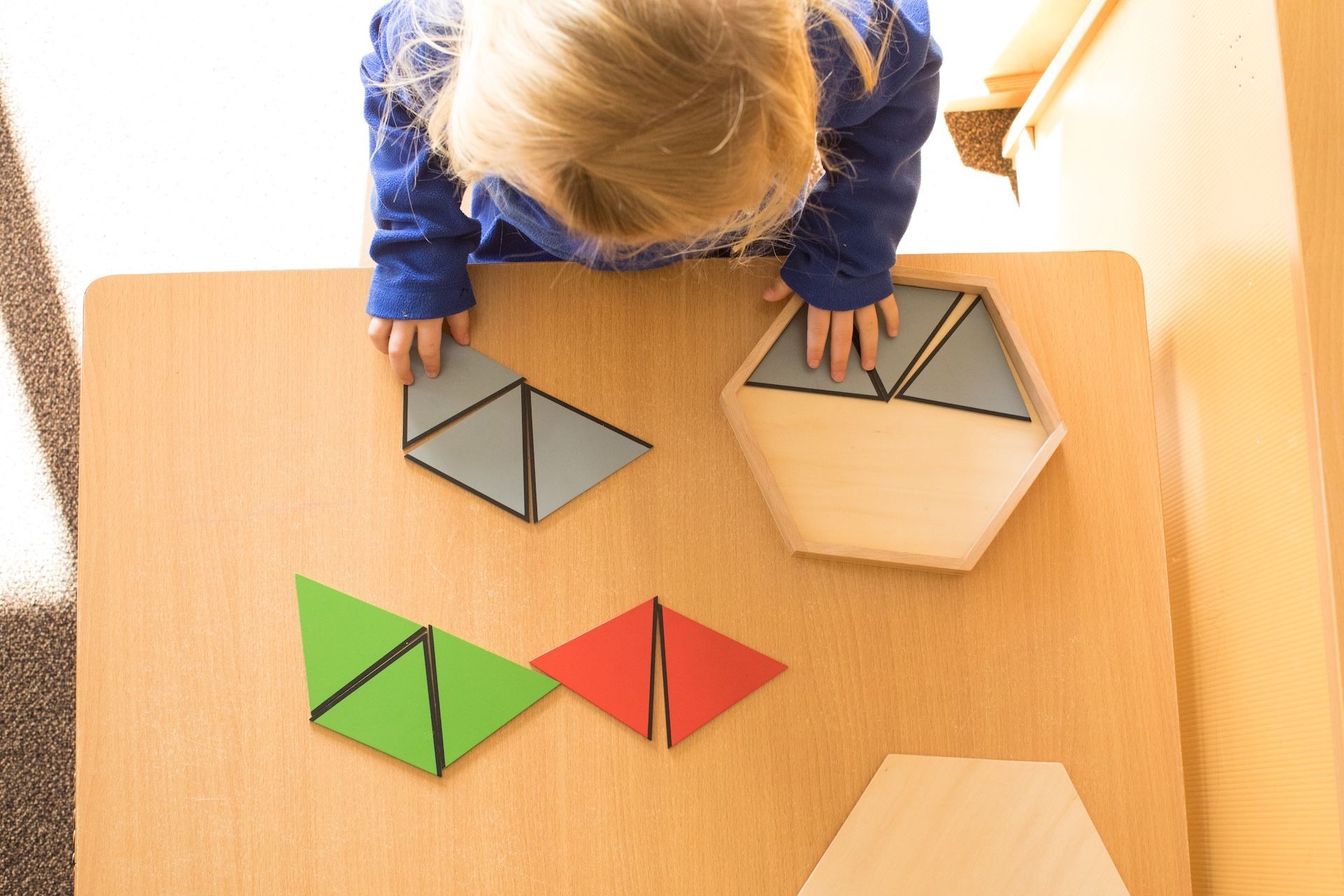
Have you ever watched a child trace the outline of a window with their finger, or carefully line up blocks into a perfectly symmetrical row? They may not have a name for what they're doing, but they are already exploring geometry. Dr. Maria Montessori understood that geometry is not an abstract school subject. It is part of the world children live in from the very beginning. A glance at the typical geometry textbook might suggest otherwise. Formulas, diagrams, and definitions can feel remote and lifeless, something to be memorized and forgotten. But look around for a moment. There is geometry in the angles of a mineral crystal and in the symmetry of a butterfly's wings. There is geometry in the legs of a chair and in the steel girders of a bridge. Children encounter it everywhere! In fact, research suggests that a basic intuitive understanding of geometric concepts may be inborn in human beings. A fascinating study of the Munduruku (an indigenous group living in the Amazon whose language includes very few spatial or geometric terms) found that both adults and children demonstrated an intuitive grasp of basic geometric ideas. This isn't something they were taught. It was already there. Montessori classrooms build on exactly this kind of inborn understanding. From Sensory Experience to Big Ideas In the early childhood years, children work with geometry through their hands. Materials like the Constructive Triangles, the Metal Insets, and the geometric cabinet give children a felt, physical understanding of shape, symmetry, and form before we introduce any formal terminology. Children gather and store these impressions. Their minds are being prepared. As they get older and certainly in the elementary years, children are ready to bring names and reasons to what they already sense. Elementary-aged children don't just want to know what something is called. They also want to know why. Why is this shape called a pentagon? (Spoiler: Its name comes from the Greek word for five: pente.) Geometry becomes a doorway into the history of language, ancient Greece, and the lives of mathematicians like Thales, Pythagoras, and Euclid, who puzzled over the same ideas thousands of years ago. This is the spirit of Cosmic Education when we pull one thread of curiosity to find it unravels into history, language, culture, and mathematics! Geometry, Algebra, and Arithmetic Woven Together One of the things that makes Montessori's approach to geometry so distinctive is that it doesn't stand alone. In the Montessori classroom, geometry is part of a three-part approach to mathematics, interwoven with arithmetic and algebra in ways that make each of them easier to understand. The Binomial Square is a good example. It presents the algebraic expression of (a + b)² = a² + 2ab + b² as a geometric pattern of squares and rectangles that children can actually build and hold. The arithmetic follows the pattern. The pattern confirms the algebra. Each one reinforces the others, and the whole thing is far more memorable than just a formula written on a board. Open-Ended, Creative, and Genuinely Fun Plus, a lot of Montessori geometry work has no single correct answer. We invite children working with the Metal Insets or Constructive Triangles to find as many equivalent figures as they can for a given shape. There may be dozens of ways to approach the same problem. This open-endedness nurtures the creative, analytical thinking that elementary children are hungry for. Plus, this quality of thinking will serve them in every area of life. Compass-and-straightedge constructions are another example. These beautiful, precise drawings challenge children in a way that is both mathematical and artistic. Many children find them deeply satisfying. What This Looks Like at Home You don't have to wait for the classroom to feed your child's geometric curiosity. Point out the shapes in a honeycomb. Notice the angles in a spider's web. Talk about the tiles on the floor or the panes in a window. Ask your child questions. Do you think that could be a triangle? How many sides does it have? These small moments of noticing are the same thing Montessori described when she wrote about preparing the environment to reflect the world children already live in. Geometry is already there. We're simply helping children see it. Come visit us in LakeCreek Montessori School to see how this unfolds in the classroom and to watch children fall in love with one of humanity's oldest ways of understanding the world.
Show More