10 Books That Are Out of This World!

Montessori Thrive • December 7, 2019

 Each and every one of us has marveled at the great vastness of space at one point or another. How could we not? Children tend to be especially enamored with the stars, planets, and other wonders beyond our own atmosphere.


 This month we share ten books that will further inspire them. Some are purely informational, while others take on a storytelling format. Some share fascinating facts, and some are peeks into the lives of people who have made a difference in our understanding of space. We hope you and your children will enjoy them!


Born With a Bang: The Universe Tells Our Cosmic Story by Jennifer Morgan, illustrated by Dana Lynne Andersen

 Gracing the shelves of Montessori elementary classrooms across the globe, this gorgeous book mirrors one of the most impressionistic lessons we give children. The beginnings of our universe can feel mysterious and full of wonder; Morgan brings the story to life in a way that gives children a sense of connection and understanding. One Montessori materials company was so inspired by this particular book that a series of materials were created to accompany it in classrooms.


A is for Astronaut: Blasting Through the Alphabet by Clayton Anderson, illustrated by Scott Brundage

 A beautifully illustrated collection of various space ideas, this book was written by a retired astronaut. Andersen applied to be an astronaut 15 times before he was accepted into the program, and he hopes the book will inspire children. In this video he talks about his path to becoming an astronaut and the making of the book.


Hidden Figures by Margot Lee Shetterly, illustrated by Laura Freeman

 Sometimes history has a bad habit of highlighting some people while minimizing the contributions of others. Fortunately, there are plenty of children’s book authors out there who are currently working hard to change that. In Hidden Figures , Margot Lee Shetterly gives voice to the stories of four black women (Dorothy Vaughan, Mary Jackson, Katherine Johnson, and Christine Darden) who supported the early work of space expeditions. Even during the time of segregation, when they were forced to work in a building separate from that of white mathematicians (or computers, as they were called then), they fought hard to follow their dreams and serve their nation.


Margaret and the Moon by Dean Robbins, illustrated by Lucy Knisley

 The woman who is famous for writing code that made four separate space missions possible started out as a young girl who was full of curiosity and determination. Margaret studied hard in school, questioned the unequal treatment of girls and women, and found inspiration in math and the universe. She went on to make history and continues to serve as a model for children today.


The Girl Who Named Pluto: The Story of Venetia Burney by Alice B. McGinty, illustrated by Elizabeth Haidle

 Did you know that this controversial planet was named after an 11-year-old girl? Venetia Burney loved dreaming about the planets, and the discovery of a ninth planet when she was a child was a dream come true. Her idea to name the planet Pluto was supported by her grandfather, and eventually, by the scientists who had discovered it. Children will love reading about the difference a young person can make!


I Am Neil Armstrong by Brad Meltzer, illustrated by Christopher Eliopoulos

 Children really enjoy Meltzer’s I Am series, and this title about Neil Armstrong is no different. Long before his journey to the moon, Armstrong was a child who worked hard and learned about persistence. Having a peek into the early years of influential figures allows our children to relate to them on a much deeper level. The comic-style illustrations and factual information are appealing to elementary-aged children.


The Darkest Dark by Chris Hadfield, illustrated by The Fan Brothers

 Hadfield, another former astronaut, wrote this book about some formative moments during his childhood. He recalls the night of the moon landing; he was just a boy and he and his family walked to a neighbor’s house to watch it on TV. He found the work of the astronauts so inspiring that he wanted to be one himself one day. In the meantime, he had to get over his fear of the dark...


Chasing Space Young Readers’ Edition by Leland Melvin

 Books written by former astronauts are more plentiful than one might think! This one was written with older children in mind - think upper elementary and middle school-aged. Once a professional American football player, Melvin faced an injury and the end of his career, until he reinvented his life and went on to help build the International Space Station. Chasing Space Young Readers’ Edition is the 2019 winner of the Grand Canyon Reader Award for tween non-fiction. There is a version written for adults, too, if you’re interested!


Welcome to Mars: Making a Home on the Red Planet by Buzz Aldrin and Marianne Dyson

 Famed Buzz Aldrin believes that humans could inhabit Mars, and he has big ideas on how that might work. He hopes to inspire children to want to learn about and explore space, and wrote this book with that aim in mind. Here, Aldrin talks a bit about his own ideas about space travel and the making of the book.


Curiosity: The Story of a Mars Rover by Markus Motus

 This book is praised for its sweet illustrations. In it, Motus semi-personifies the Mars rover Curiosity , but the information shared is factual. Children will be amazed by the interesting facts about space as well as delighted by the mission of the rover.


 Have you and your children read any other great books about space? Let us know! We would love to hear what you would add to the list.

Child working with the moveable alphabet on a working mat.
October 26, 2026
Learn how Maria Montessori's "sensitive periods" guide your child's natural passion for learning, focus, and independence at LakeCreek Montessori.
Close-up of a silver-topped wooden bell, with more pieces blurred in the background
October 19, 2026
Discover how music is integrated into daily life in LakeCreek Montessori's Toddler and Primary classrooms through the Montessori Bells, singing, and movement.
Two using the smelling bottles at a wooden table in a bright classroom
October 12, 2026
Discover how the Montessori approach develops your child's internal will, self-regulation, and true independence in our Toddler and Primary classrooms at LakeCreek.
Child plays with colorful sensory materials at a table indoors.
October 5, 2026
Discover how the uninterrupted 3-hour work cycle in a Montessori classroom fosters deep focus, independence, and a state of flow for your child.
Child in a pink apron arranging fruit on a table in a bright kitchen.
September 28, 2026
Discover how grace and courtesy lessons at LakeCreek Montessori School help children build empathy, social confidence, and deep respect for others.
Child in a cardboard pirate ship craft, painted brown and blue, with white waves in a classroom.
September 21, 2026
Step inside a LakeCreek Montessori classroom to discover how uninterrupted work cycles, child-led choices, and trained guides foster deep focus and lifelong independence.
Child playing with colorful toy food on a table beside a brown basket in a bright room
September 14, 2026
Explore how LakeCreek Montessori School builds a peaceful, order-filled community for toddlers and young children, supporting emotional growth and lifelong independence.
Person arranging a colorful mountain landscape collage on a board with glue and paper cutouts.
September 7, 2026
Discover how authentic Montessori education at LakeCreek Montessori School prepares children for an unpredictable future through independence, strong academics, and executive function.
By LakeCreek Montessori School • June 24, 2026
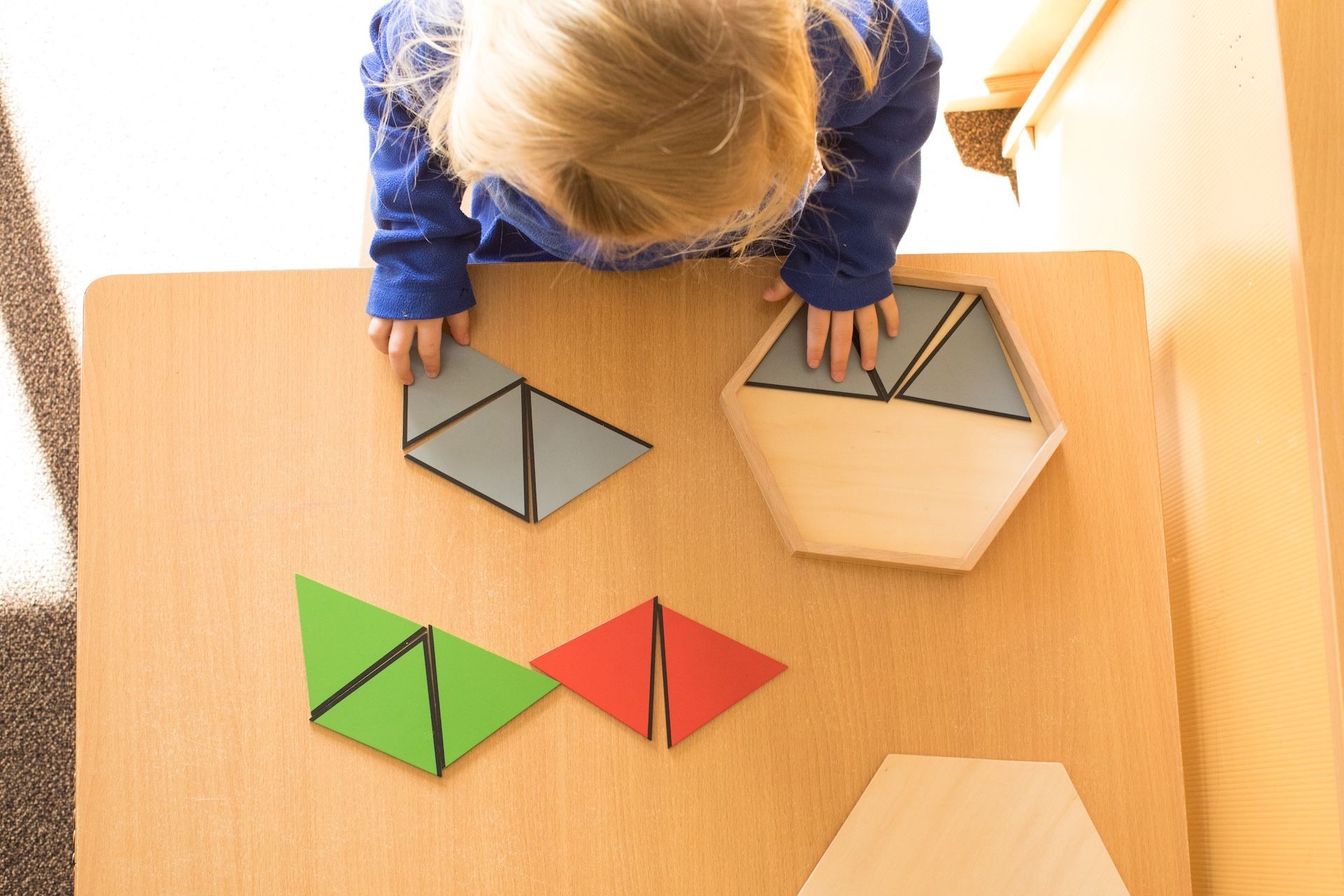
Have you ever watched a child trace the outline of a window with their finger, or carefully line up blocks into a perfectly symmetrical row? They may not have a name for what they're doing, but they are already exploring geometry. Dr. Maria Montessori understood that geometry is not an abstract school subject. It is part of the world children live in from the very beginning. A glance at the typical geometry textbook might suggest otherwise. Formulas, diagrams, and definitions can feel remote and lifeless, something to be memorized and forgotten. But look around for a moment. There is geometry in the angles of a mineral crystal and in the symmetry of a butterfly's wings. There is geometry in the legs of a chair and in the steel girders of a bridge. Children encounter it everywhere! In fact, research suggests that a basic intuitive understanding of geometric concepts may be inborn in human beings. A fascinating study of the Munduruku (an indigenous group living in the Amazon whose language includes very few spatial or geometric terms) found that both adults and children demonstrated an intuitive grasp of basic geometric ideas. This isn't something they were taught. It was already there. Montessori classrooms build on exactly this kind of inborn understanding. From Sensory Experience to Big Ideas In the early childhood years, children work with geometry through their hands. Materials like the Constructive Triangles, the Metal Insets, and the geometric cabinet give children a felt, physical understanding of shape, symmetry, and form before we introduce any formal terminology. Children gather and store these impressions. Their minds are being prepared. As they get older and certainly in the elementary years, children are ready to bring names and reasons to what they already sense. Elementary-aged children don't just want to know what something is called. They also want to know why. Why is this shape called a pentagon? (Spoiler: Its name comes from the Greek word for five: pente.) Geometry becomes a doorway into the history of language, ancient Greece, and the lives of mathematicians like Thales, Pythagoras, and Euclid, who puzzled over the same ideas thousands of years ago. This is the spirit of Cosmic Education when we pull one thread of curiosity to find it unravels into history, language, culture, and mathematics! Geometry, Algebra, and Arithmetic Woven Together One of the things that makes Montessori's approach to geometry so distinctive is that it doesn't stand alone. In the Montessori classroom, geometry is part of a three-part approach to mathematics, interwoven with arithmetic and algebra in ways that make each of them easier to understand. The Binomial Square is a good example. It presents the algebraic expression of (a + b)² = a² + 2ab + b² as a geometric pattern of squares and rectangles that children can actually build and hold. The arithmetic follows the pattern. The pattern confirms the algebra. Each one reinforces the others, and the whole thing is far more memorable than just a formula written on a board. Open-Ended, Creative, and Genuinely Fun Plus, a lot of Montessori geometry work has no single correct answer. We invite children working with the Metal Insets or Constructive Triangles to find as many equivalent figures as they can for a given shape. There may be dozens of ways to approach the same problem. This open-endedness nurtures the creative, analytical thinking that elementary children are hungry for. Plus, this quality of thinking will serve them in every area of life. Compass-and-straightedge constructions are another example. These beautiful, precise drawings challenge children in a way that is both mathematical and artistic. Many children find them deeply satisfying. What This Looks Like at Home You don't have to wait for the classroom to feed your child's geometric curiosity. Point out the shapes in a honeycomb. Notice the angles in a spider's web. Talk about the tiles on the floor or the panes in a window. Ask your child questions. Do you think that could be a triangle? How many sides does it have? These small moments of noticing are the same thing Montessori described when she wrote about preparing the environment to reflect the world children already live in. Geometry is already there. We're simply helping children see it. Come visit us in LakeCreek Montessori School to see how this unfolds in the classroom and to watch children fall in love with one of humanity's oldest ways of understanding the world.
By LakeCreek Montessori School • June 24, 2026
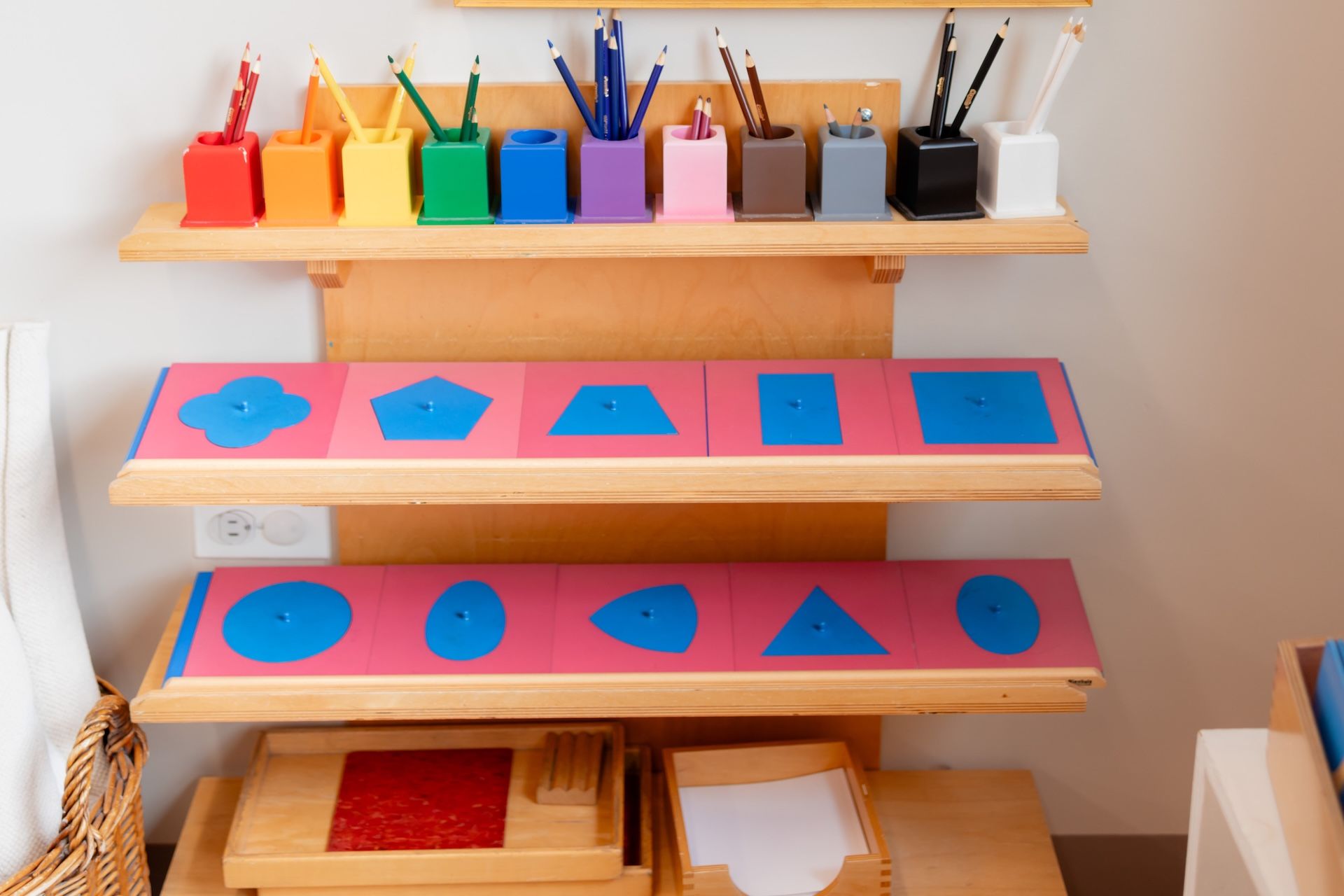
unfold over time. Children begin with a single frame and inset, using three colored pencils: one for tracing the frame, one for tracing the inset, and one for filling in. As their control deepens, subsequent exercises introduce the use of insets only (without frames), multiple overlapping shapes, repeated tracings of a single shape in different positions, and eventually fully free geometric design using any combination of insets, colors, and orientations. One of the most beautiful exercises is graded color. Using a single inset and a single pencil, children fill the shape with vertical lines, moving from darker to lighter (or lighter to darker) by adjusting the pencil pressure. This exercise requires an extraordinary sensitivity of touch, and when children achieve it, the result is genuinely lovely. This work can continue throughout a child’s entire time in the Children’s House. It can be relaxing and meditative, and when older children do it with great refinement, it naturally inspires younger children who observe them. Readiness and Timing Two key preparations precede the metal insets. Children should be able to trace the shapes of the geometry cabinet and the leaf shapes of the leaf cabinet using a stylus, and ideally they should be working with the movable alphabet. Timing matters. If we introduce the work too soon, before the hand is ready, it becomes too great a challenge rather than a satisfying one. The guide’s role is to observe carefully and to offer the presentation at the moment when it will be received with both readiness and joy. The metal insets are a landmark in the child’s journey toward written language. This layered preparation honors both the intelligence of the hand and the unhurried nature of true readiness. We invite you to come see the metal insets and the full breadth of our carefully prepared environment in person. Contact us to schedule a visit here in LakeCreek Montessori School or to learn more about life in our Children’s House.
Show More