Books to Read Before Family Movie Night

Montessori Thrive • December 17, 2020

There are SO many incredible pieces of children’s literature that have eventually been made into movies. In this article, we’d like to share just a few of our favorites. With a bit of extra time at home together, you might enjoy reading one of these books together, then watching the movie. Children love noticing the similarities and differences, plus doing so is great for building reading comprehension skills.

The Polar Express by Chris Van Allsburg

The classic Christmas tale is appealing to both children and adults. It’s hard to tell which is more magical - the story of a boy’s journey to the North Pole or the stunningly gorgeous illustrations. So many movies stray noticeably far from their original book inspiration, but this one does not. The movie evokes the same feel of the book’s plot and artwork.


Shrek! by William Steig

Many of us are familiar with the animated classic, but did you know that Shrek! originated as a hilariously disgusting children’s book? Shrek reaches an age at which his parents decide to kick him out of their swamp and out on his own. Shrek prides himself on his repulsiveness, and after meeting a fortune-telling witch on his journey, he sets out on a mission to find his princess.


Where the Wild Things Are by Maurice Sendak

Max, like most children, is replete with mischief. Unfortunately, one evening, his mother has had enough of his antics and sends him to bed with no supper. Whether Max slips into a dream or sets out on a journey is left for readers to wonder, but his travels take him across vast oceans to a land of mysterious beasts, of which he becomes the leader.


The BFG by Roald Dahl, illustrated by Quentin Blake

One evening Sophie peeks out her bedroom window, only to see a large creature. When the creature sees her, he packs her up with his things and takes her away to his distant home. Luckily, for Sophie, the creature is the BFG, or the Big Friendly Giant. They become fast friends on a mission to save the world from the other giants, who are even bigger and not the least bit friendly.


The Ramona series by Beverly Cleary

Children have loved this relatable series for generations. Romana and her big sister Beezus, their cat Picky-Picky, and their parents live on Klickitat Street. The books explore all sorts of phases and situations children understand, including sibling relationships, friendships, starting at a new school, negotiating with parents, having to spend time with a babysitter, mischief caused by pets, preparing for a new baby, and so much more.


Because of Winn Dixie by Kate DiCamillo

Young Opal is new in town, and she and her father the preacher are all alone. Opal thinks about her mother, who left when she was three years old, and wishes she knew more about her. One day, while Opal was in the Winn Dixie grocery store, a stray dog snuck in and began running around the produce aisle. It was on that day Opal claimed him as her own, named him Winn Dixie, brought him home for a bath, and her life began to change.


Charlotte’s Web by E.B. White

Fern, a precocious child, begs and pleads with her father in an attempt to save the life of a young runt pig. Her father capitulates, and Fern cares for the growing pig (Wilbur) until he is too large and is sent to live at her uncle’s nearby farm. It is here that Wilbur meets a new friend - a spider named Charlotte. After learning about Wilbur’s unfortunate probable fate, he and Charlotte work together in an attempt to save him, securing his safety and cementing their friendship.


The Witches by Roald Dahl, illustrated by Quentin Blake

A young boy and his grandmother take a vacation together, during which they find themselves inadvertently amongst a convention of witches. Witches, in Dahl’s tale, look very much like ordinary women, but after a childhood mishap, the grandmother knows exactly how to spot one. She teaches her grandson all she knows, and the two work together in hopes of protecting children everywhere.


Bridge to Terabithia by Katherine Paterson

Be warned: this book is beautifully written, but terribly sad. Jesse and Leslie are both in need of a friend. They are neighbors, the same age, and seem to have a lot in common - even when they don’t. Near the creek by their homes, they create an imaginary world that they both retreat to as often as possible. Their friendship grows, and Jesse’s life changes for the better. One day when Jesse is away, he returns to discover a horrible tragedy.

The Hobbit by JR.R. Tolkien

Bilbo Baggins is a hobbit; and imaginary creature of Tolkien’s creation. This is a story of an epic journey which Baggins takes in hopes of winning a share of a treasure guarded by a dragon. Throughout his journey, he grows as a character in various ways. Another well-known book and sequel to The Hobbit is The Lord of the Rings.

We hope you enjoy our book selections this month!

Warm regards,

Candice Lin, Director
info@jordanmontessori.com


Child working with the moveable alphabet on a working mat.
October 26, 2026
Learn how Maria Montessori's "sensitive periods" guide your child's natural passion for learning, focus, and independence at LakeCreek Montessori.
Close-up of a silver-topped wooden bell, with more pieces blurred in the background
October 19, 2026
Discover how music is integrated into daily life in LakeCreek Montessori's Toddler and Primary classrooms through the Montessori Bells, singing, and movement.
Two using the smelling bottles at a wooden table in a bright classroom
October 12, 2026
Discover how the Montessori approach develops your child's internal will, self-regulation, and true independence in our Toddler and Primary classrooms at LakeCreek.
Child plays with colorful sensory materials at a table indoors.
October 5, 2026
Discover how the uninterrupted 3-hour work cycle in a Montessori classroom fosters deep focus, independence, and a state of flow for your child.
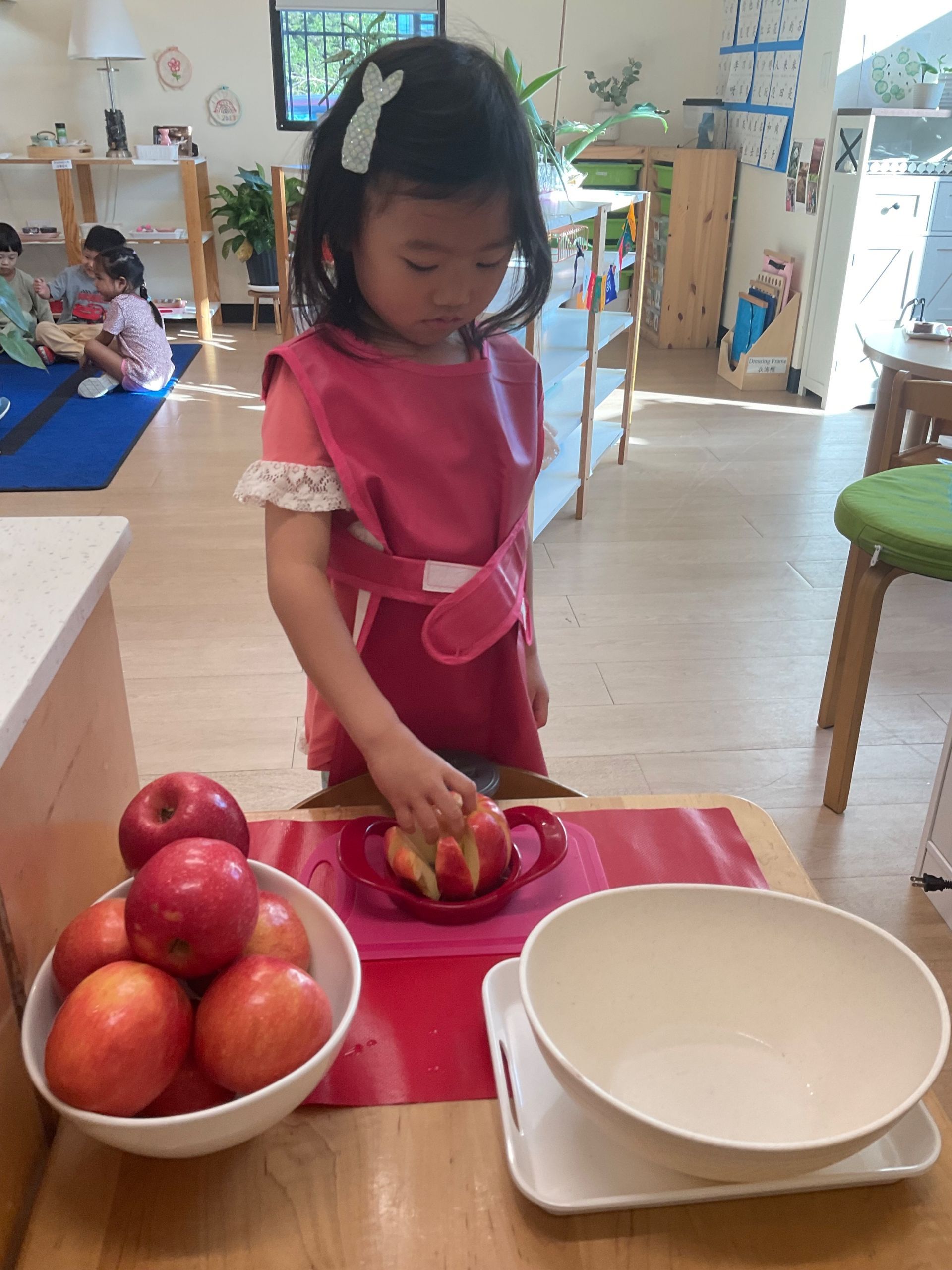
Child in a pink apron arranging fruit on a table in a bright kitchen.
September 28, 2026
Discover how grace and courtesy lessons at LakeCreek Montessori School help children build empathy, social confidence, and deep respect for others.
Child in a cardboard pirate ship craft, painted brown and blue, with white waves in a classroom.
September 21, 2026
Step inside a LakeCreek Montessori classroom to discover how uninterrupted work cycles, child-led choices, and trained guides foster deep focus and lifelong independence.
Child playing with colorful toy food on a table beside a brown basket in a bright room
September 14, 2026
Explore how LakeCreek Montessori School builds a peaceful, order-filled community for toddlers and young children, supporting emotional growth and lifelong independence.
Person arranging a colorful mountain landscape collage on a board with glue and paper cutouts.
September 7, 2026
Discover how authentic Montessori education at LakeCreek Montessori School prepares children for an unpredictable future through independence, strong academics, and executive function.
By LakeCreek Montessori School • June 24, 2026
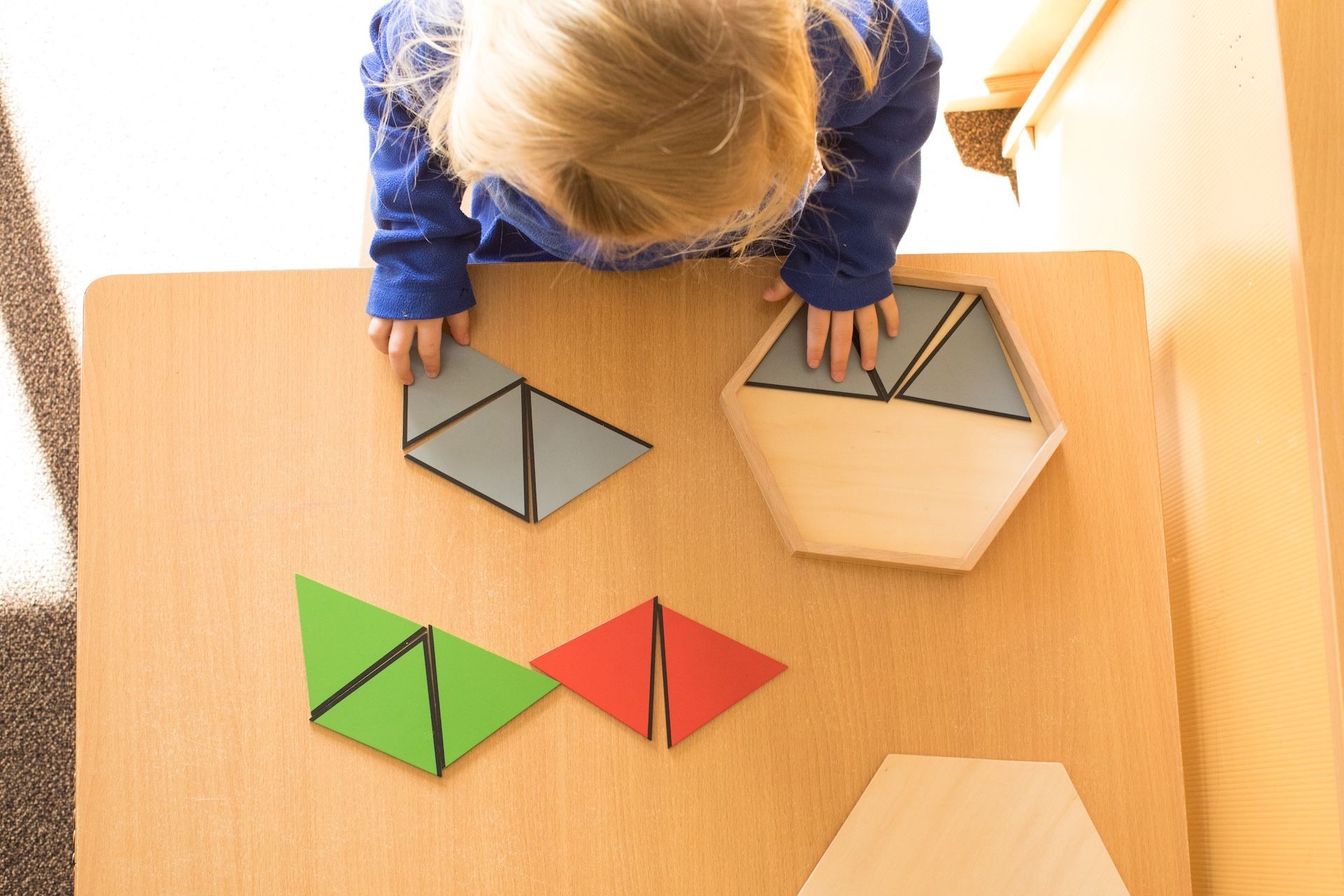
Have you ever watched a child trace the outline of a window with their finger, or carefully line up blocks into a perfectly symmetrical row? They may not have a name for what they're doing, but they are already exploring geometry. Dr. Maria Montessori understood that geometry is not an abstract school subject. It is part of the world children live in from the very beginning. A glance at the typical geometry textbook might suggest otherwise. Formulas, diagrams, and definitions can feel remote and lifeless, something to be memorized and forgotten. But look around for a moment. There is geometry in the angles of a mineral crystal and in the symmetry of a butterfly's wings. There is geometry in the legs of a chair and in the steel girders of a bridge. Children encounter it everywhere! In fact, research suggests that a basic intuitive understanding of geometric concepts may be inborn in human beings. A fascinating study of the Munduruku (an indigenous group living in the Amazon whose language includes very few spatial or geometric terms) found that both adults and children demonstrated an intuitive grasp of basic geometric ideas. This isn't something they were taught. It was already there. Montessori classrooms build on exactly this kind of inborn understanding. From Sensory Experience to Big Ideas In the early childhood years, children work with geometry through their hands. Materials like the Constructive Triangles, the Metal Insets, and the geometric cabinet give children a felt, physical understanding of shape, symmetry, and form before we introduce any formal terminology. Children gather and store these impressions. Their minds are being prepared. As they get older and certainly in the elementary years, children are ready to bring names and reasons to what they already sense. Elementary-aged children don't just want to know what something is called. They also want to know why. Why is this shape called a pentagon? (Spoiler: Its name comes from the Greek word for five: pente.) Geometry becomes a doorway into the history of language, ancient Greece, and the lives of mathematicians like Thales, Pythagoras, and Euclid, who puzzled over the same ideas thousands of years ago. This is the spirit of Cosmic Education when we pull one thread of curiosity to find it unravels into history, language, culture, and mathematics! Geometry, Algebra, and Arithmetic Woven Together One of the things that makes Montessori's approach to geometry so distinctive is that it doesn't stand alone. In the Montessori classroom, geometry is part of a three-part approach to mathematics, interwoven with arithmetic and algebra in ways that make each of them easier to understand. The Binomial Square is a good example. It presents the algebraic expression of (a + b)² = a² + 2ab + b² as a geometric pattern of squares and rectangles that children can actually build and hold. The arithmetic follows the pattern. The pattern confirms the algebra. Each one reinforces the others, and the whole thing is far more memorable than just a formula written on a board. Open-Ended, Creative, and Genuinely Fun Plus, a lot of Montessori geometry work has no single correct answer. We invite children working with the Metal Insets or Constructive Triangles to find as many equivalent figures as they can for a given shape. There may be dozens of ways to approach the same problem. This open-endedness nurtures the creative, analytical thinking that elementary children are hungry for. Plus, this quality of thinking will serve them in every area of life. Compass-and-straightedge constructions are another example. These beautiful, precise drawings challenge children in a way that is both mathematical and artistic. Many children find them deeply satisfying. What This Looks Like at Home You don't have to wait for the classroom to feed your child's geometric curiosity. Point out the shapes in a honeycomb. Notice the angles in a spider's web. Talk about the tiles on the floor or the panes in a window. Ask your child questions. Do you think that could be a triangle? How many sides does it have? These small moments of noticing are the same thing Montessori described when she wrote about preparing the environment to reflect the world children already live in. Geometry is already there. We're simply helping children see it. Come visit us in LakeCreek Montessori School to see how this unfolds in the classroom and to watch children fall in love with one of humanity's oldest ways of understanding the world.
By LakeCreek Montessori School • June 24, 2026
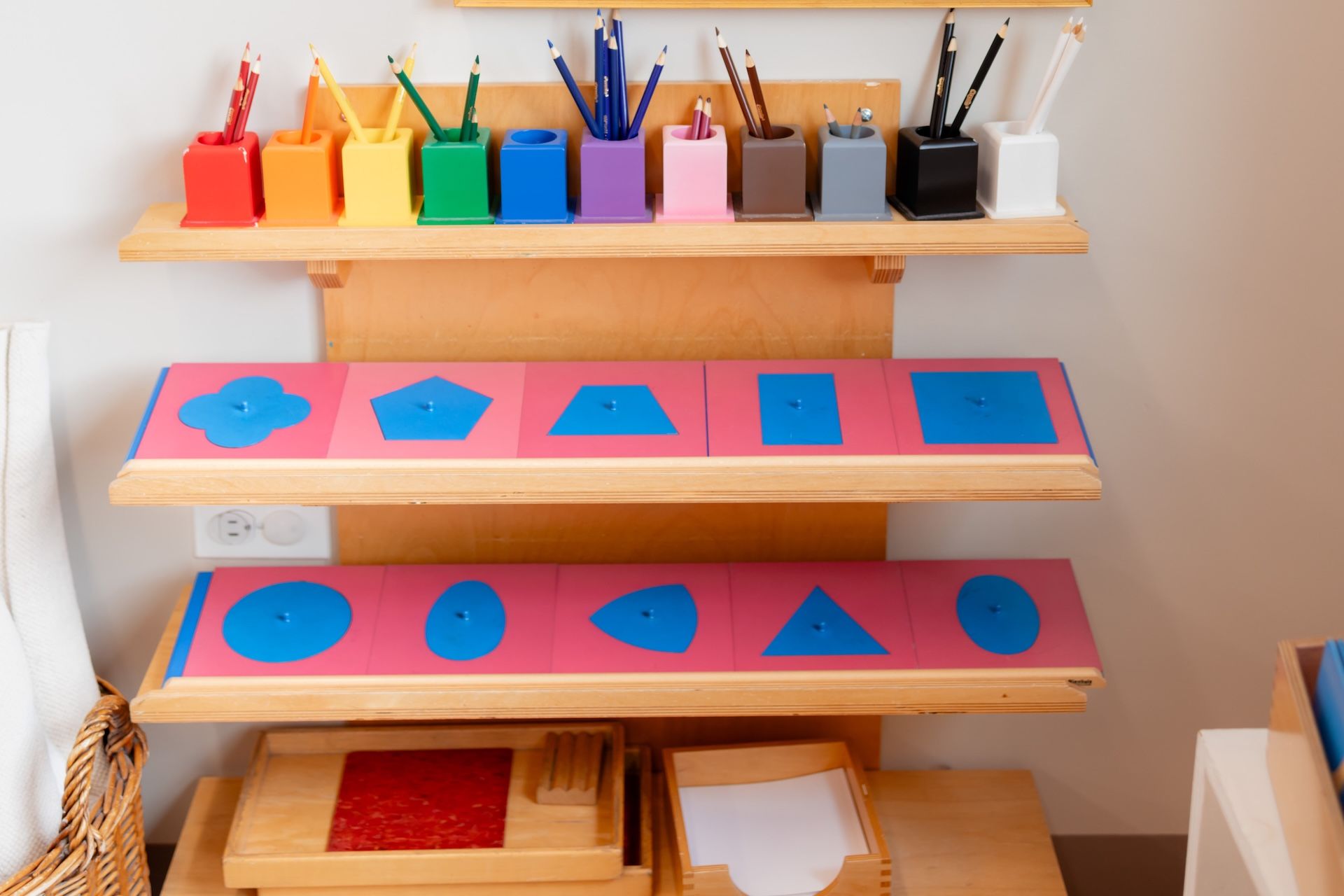
unfold over time. Children begin with a single frame and inset, using three colored pencils: one for tracing the frame, one for tracing the inset, and one for filling in. As their control deepens, subsequent exercises introduce the use of insets only (without frames), multiple overlapping shapes, repeated tracings of a single shape in different positions, and eventually fully free geometric design using any combination of insets, colors, and orientations. One of the most beautiful exercises is graded color. Using a single inset and a single pencil, children fill the shape with vertical lines, moving from darker to lighter (or lighter to darker) by adjusting the pencil pressure. This exercise requires an extraordinary sensitivity of touch, and when children achieve it, the result is genuinely lovely. This work can continue throughout a child’s entire time in the Children’s House. It can be relaxing and meditative, and when older children do it with great refinement, it naturally inspires younger children who observe them. Readiness and Timing Two key preparations precede the metal insets. Children should be able to trace the shapes of the geometry cabinet and the leaf shapes of the leaf cabinet using a stylus, and ideally they should be working with the movable alphabet. Timing matters. If we introduce the work too soon, before the hand is ready, it becomes too great a challenge rather than a satisfying one. The guide’s role is to observe carefully and to offer the presentation at the moment when it will be received with both readiness and joy. The metal insets are a landmark in the child’s journey toward written language. This layered preparation honors both the intelligence of the hand and the unhurried nature of true readiness. We invite you to come see the metal insets and the full breadth of our carefully prepared environment in person. Contact us to schedule a visit here in LakeCreek Montessori School or to learn more about life in our Children’s House.
Show More