Family-School Partnership

LakeCreek Montessori School • January 8, 2024

Our children really thrive when home and school environments work cooperatively, communicate well, and share similar educational values and expectations. When families devote sincere effort to learning about Montessori principles and how to reinforce these at home, there are positive effects. We want to partner with you in support of your child!


What does a home-school partnership look like in action? 


In order to reinforce and extend your child’s experience at school, we recommend exploring how to support your child’s independence and problem-solving, staying up to date with school-home communication, and learning about positive-based discipline.


Supporting Independence


To support independence, it’s important to remember that even the youngest child can engage in real-life activities around the house. They can help set the table, fold the laundry, feed any pets, and tidy a room. Older children can contribute to home life by participating in household chores such as loading and emptying the dishwasher, putting away groceries, gathering trash/recycling, preparing simple meals, and more elaborate pet care. 


In this process, we want to provide children practice with self-care skills. This can range from putting on their own shoes, to picking out their clothes for the next day, to planning and packing their lunches. Providing children with these opportunities builds independence, confidence, and life skills. Even with very young children, the Montessori approach is “help me to do it myself.” 


We also want to give our children the opportunity to overcome challenges. They might struggle to get their shoes on at first. Rather than swoop and just quickly do it for them, we can break down the steps and offer some simple verbal guidance: open the velcro first, pull here, open the straps, slide your toes into the shoe, push down, etc. With older children, this scaffolding may take the form of brainstorming how to communicate with friends about a social misunderstanding, or offering to draft an email together to the teacher to share what has been upsetting your child. When we provide support for problem-solving rather than “fixing” a problem, we help our children build self-esteem, their sense of purpose, and the determination to master life skills. 


Communication is Key


Although staying up to date with communication seems like a simple step to staying in partnership, lives get so busy! To prioritize our children’s educational experience, we can take some simple steps to make sure we are in alignment and not working at cross purposes. 


At the core, we want to maintain respectful, direct, and active communication with each other. This can be as simple as communicating with your child’s guide(s) in a timely manner about significant changes or events in your child’s life. Life outside of school has an impact on your child’s classroom experience, and communicating with your child’s guides will allow them to better support your child during times of transition or challenge. 


Although conferences offer a lovely opportunity to collaborate, please remember that you don’t have to wait until regularly scheduled conferences! Please share observations and concerns about your child or their classroom experience directly with the child’s lead guide. Doing so allows the adults at school to be more responsive to your child’s needs in a timely manner. We want to know your thoughts and feelings sooner than later! 


Another good step is to familiarize yourself with the handbook each year. It’s easy to think it only requires one read, but it’s worth revisiting the handbook annually to review school policies and remember important procedures and expectations. Similarly, reading communications from the school and classroom is an effective way to stay current about any updates or changes and to build a trusting partnership with your child’s classroom guides. 


We want to hear and understand your perspective. We also want to share how we work to uphold the mission and vision of the school and Montessori pedagogy in a way that balances individual needs with community needs. Communication is key!


Practice Positivity


We work hard to model respect and positivity. To support this, we ask that you also model respect for your child. This can take the form of practicing positive discipline (read more about this on the Positive Discipline website).


Practicing positivity can also mean assuming the best intent. For example, if misunderstanding or conflicts arise, either at home or at school, as adults we can demonstrate respect. We can work toward resolution with graciousness and model being open to hearing another’s perspective. Children are watching and listening. If we speak of community members in positive terms, even if there is a concern or disagreement, our children will learn how to approach potentially tense situations with thought and care. 


Thank you for being willing to understand and support the school’s policies, stay in communication, support independence, and serve as a role model for all children. We appreciate it when families are willing to learn about and trust the Montessori model of education. This awareness helps us work together to collaboratively support children’s development most effectively. Children thrive when they experience their home and school environments as being in sync! 


One of the best ways to learn more about the Montessori experience is to observe. Schedule a tour! We would love to connect!

Child working with the moveable alphabet on a working mat.
October 26, 2026
Learn how Maria Montessori's "sensitive periods" guide your child's natural passion for learning, focus, and independence at LakeCreek Montessori.
Close-up of a silver-topped wooden bell, with more pieces blurred in the background
October 19, 2026
Discover how music is integrated into daily life in LakeCreek Montessori's Toddler and Primary classrooms through the Montessori Bells, singing, and movement.
Two using the smelling bottles at a wooden table in a bright classroom
October 12, 2026
Discover how the Montessori approach develops your child's internal will, self-regulation, and true independence in our Toddler and Primary classrooms at LakeCreek.
Child plays with colorful sensory materials at a table indoors.
October 5, 2026
Discover how the uninterrupted 3-hour work cycle in a Montessori classroom fosters deep focus, independence, and a state of flow for your child.
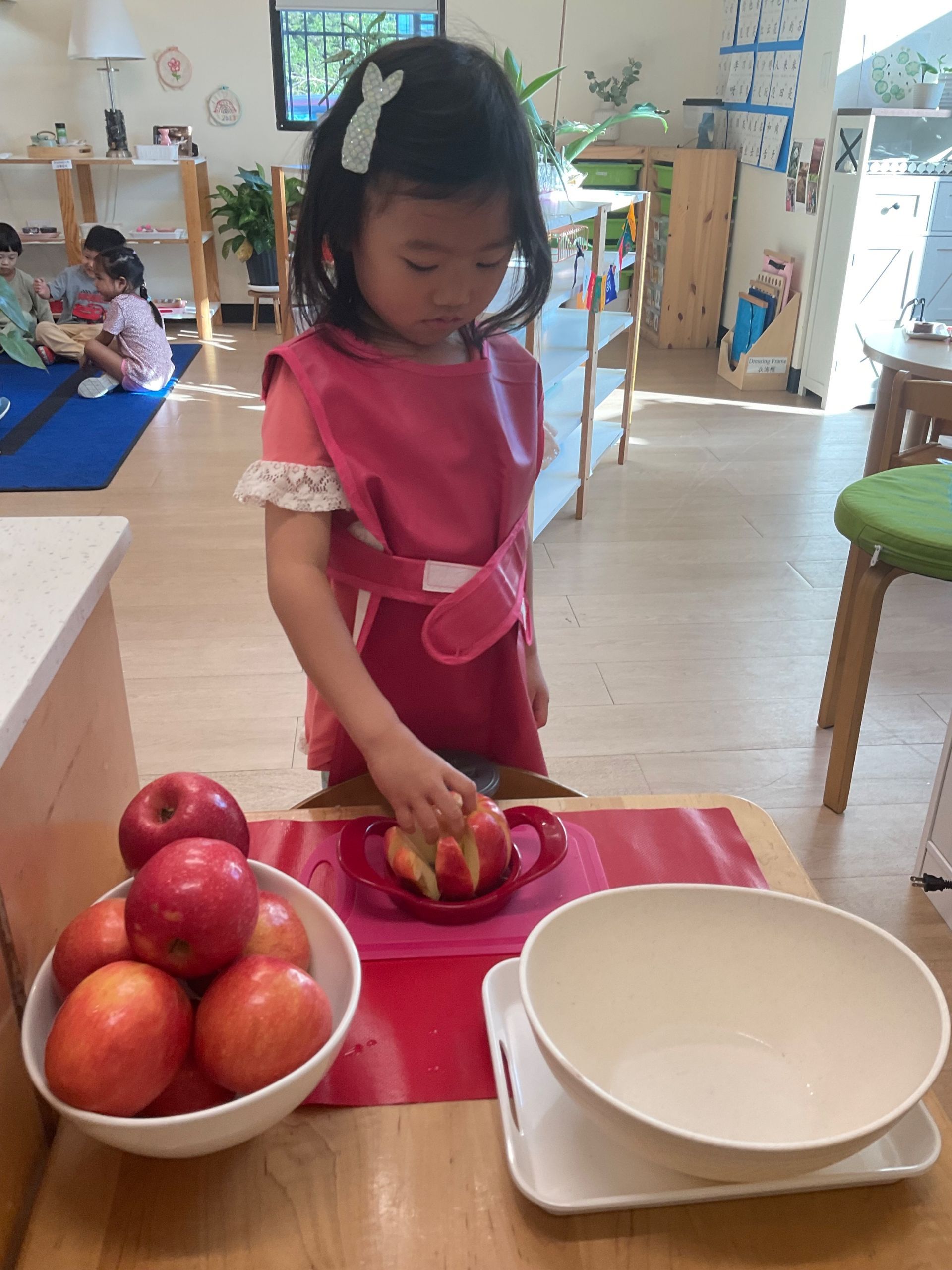
Child in a pink apron arranging fruit on a table in a bright kitchen.
September 28, 2026
Discover how grace and courtesy lessons at LakeCreek Montessori School help children build empathy, social confidence, and deep respect for others.
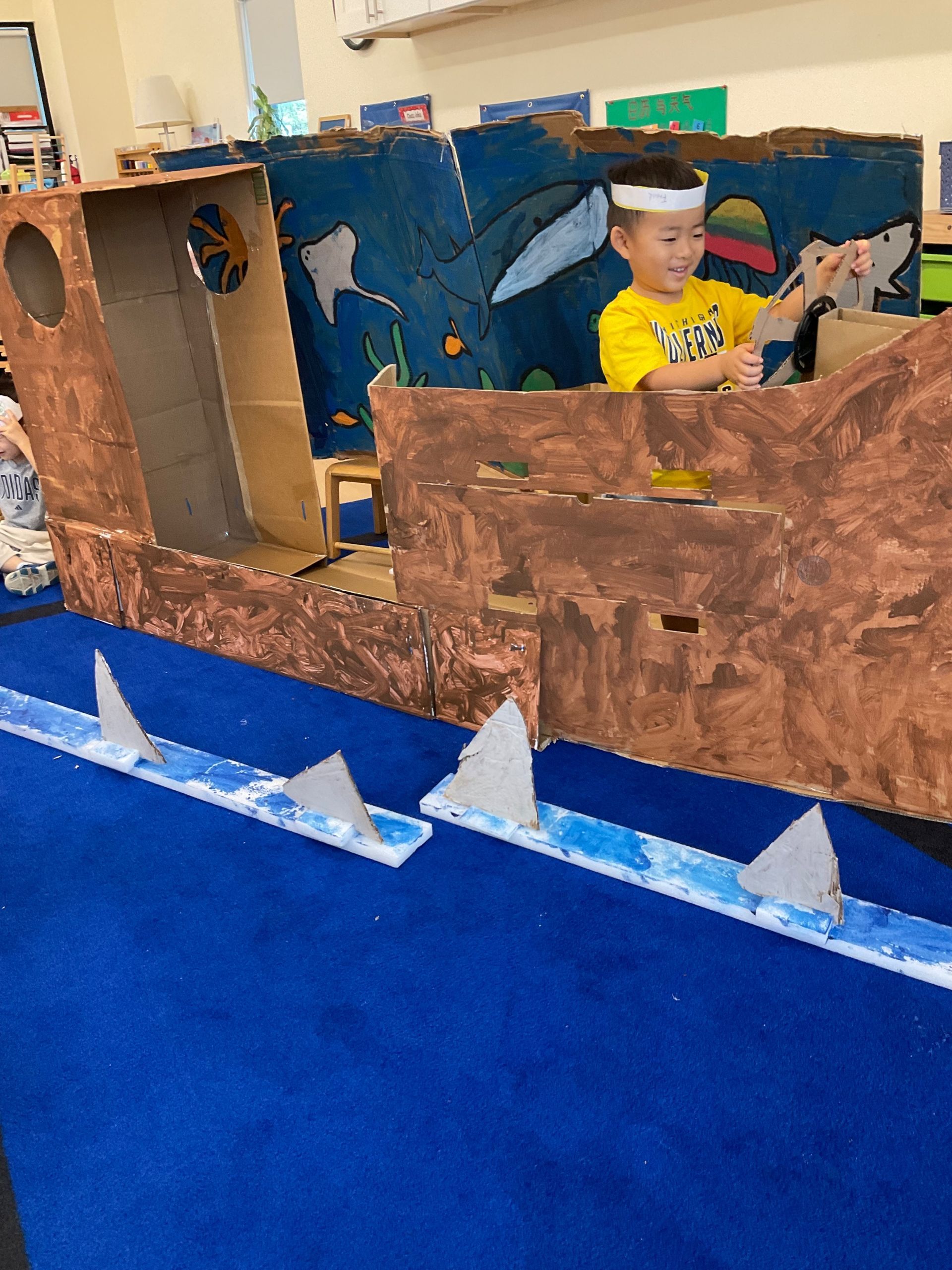
Child in a cardboard pirate ship craft, painted brown and blue, with white waves in a classroom.
September 21, 2026
Step inside a LakeCreek Montessori classroom to discover how uninterrupted work cycles, child-led choices, and trained guides foster deep focus and lifelong independence.
Child playing with colorful toy food on a table beside a brown basket in a bright room
September 14, 2026
Explore how LakeCreek Montessori School builds a peaceful, order-filled community for toddlers and young children, supporting emotional growth and lifelong independence.
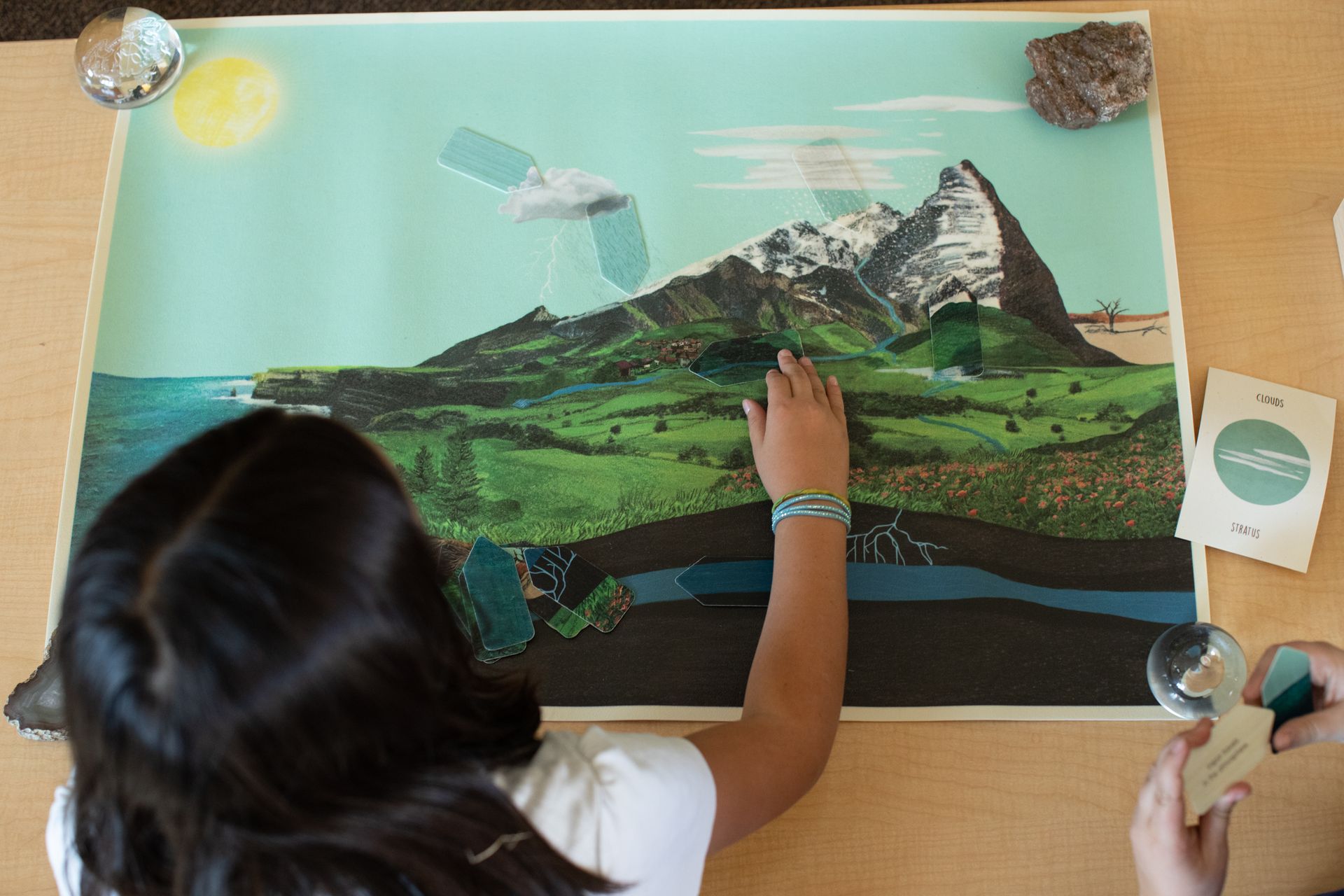
Person arranging a colorful mountain landscape collage on a board with glue and paper cutouts.
September 7, 2026
Discover how authentic Montessori education at LakeCreek Montessori School prepares children for an unpredictable future through independence, strong academics, and executive function.
By LakeCreek Montessori School • June 24, 2026
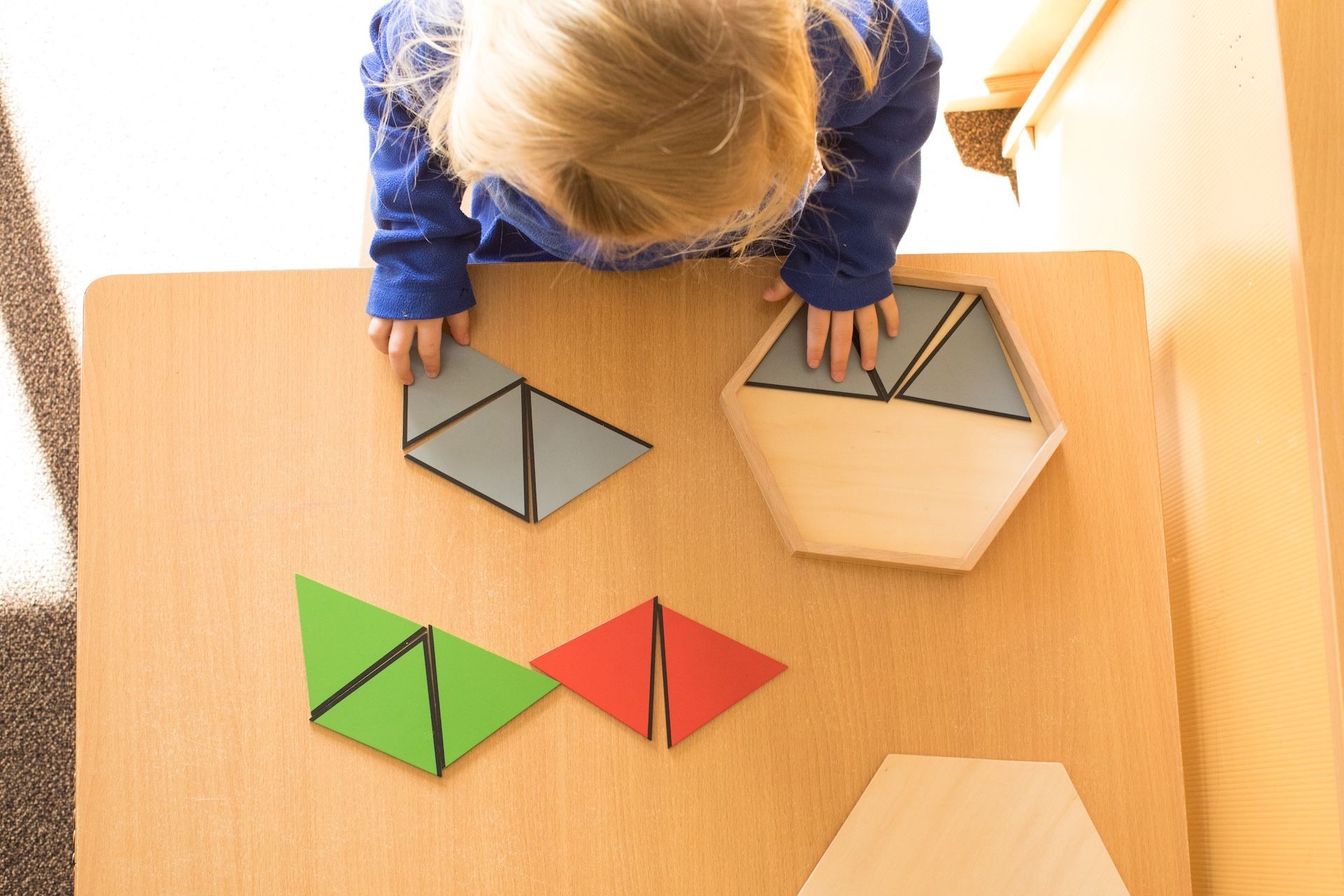
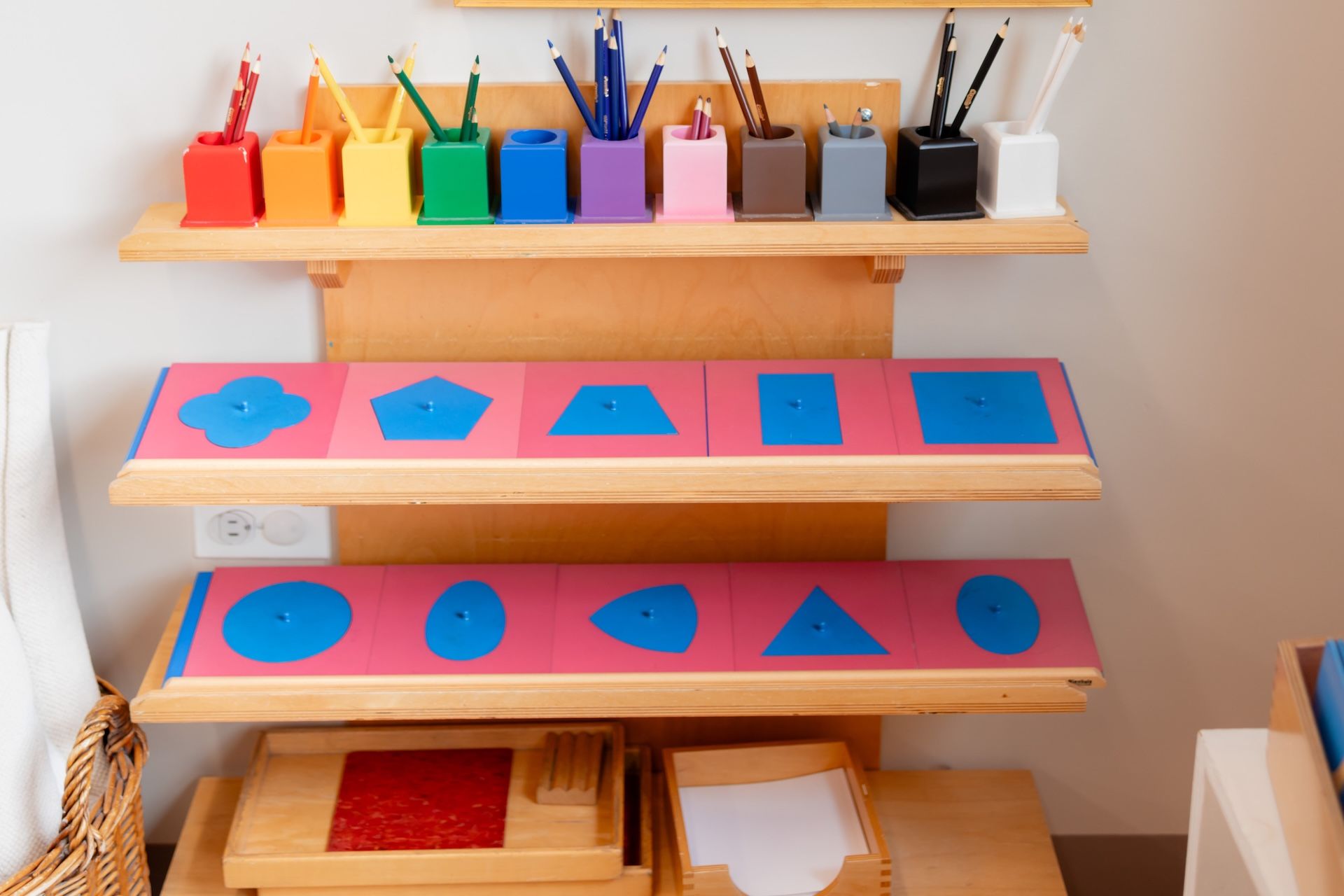
Have you ever watched a child trace the outline of a window with their finger, or carefully line up blocks into a perfectly symmetrical row? They may not have a name for what they're doing, but they are already exploring geometry. Dr. Maria Montessori understood that geometry is not an abstract school subject. It is part of the world children live in from the very beginning. A glance at the typical geometry textbook might suggest otherwise. Formulas, diagrams, and definitions can feel remote and lifeless, something to be memorized and forgotten. But look around for a moment. There is geometry in the angles of a mineral crystal and in the symmetry of a butterfly's wings. There is geometry in the legs of a chair and in the steel girders of a bridge. Children encounter it everywhere! In fact, research suggests that a basic intuitive understanding of geometric concepts may be inborn in human beings. A fascinating study of the Munduruku (an indigenous group living in the Amazon whose language includes very few spatial or geometric terms) found that both adults and children demonstrated an intuitive grasp of basic geometric ideas. This isn't something they were taught. It was already there. Montessori classrooms build on exactly this kind of inborn understanding. From Sensory Experience to Big Ideas In the early childhood years, children work with geometry through their hands. Materials like the Constructive Triangles, the Metal Insets, and the geometric cabinet give children a felt, physical understanding of shape, symmetry, and form before we introduce any formal terminology. Children gather and store these impressions. Their minds are being prepared. As they get older and certainly in the elementary years, children are ready to bring names and reasons to what they already sense. Elementary-aged children don't just want to know what something is called. They also want to know why. Why is this shape called a pentagon? (Spoiler: Its name comes from the Greek word for five: pente.) Geometry becomes a doorway into the history of language, ancient Greece, and the lives of mathematicians like Thales, Pythagoras, and Euclid, who puzzled over the same ideas thousands of years ago. This is the spirit of Cosmic Education when we pull one thread of curiosity to find it unravels into history, language, culture, and mathematics! Geometry, Algebra, and Arithmetic Woven Together One of the things that makes Montessori's approach to geometry so distinctive is that it doesn't stand alone. In the Montessori classroom, geometry is part of a three-part approach to mathematics, interwoven with arithmetic and algebra in ways that make each of them easier to understand. The Binomial Square is a good example. It presents the algebraic expression of (a + b)² = a² + 2ab + b² as a geometric pattern of squares and rectangles that children can actually build and hold. The arithmetic follows the pattern. The pattern confirms the algebra. Each one reinforces the others, and the whole thing is far more memorable than just a formula written on a board. Open-Ended, Creative, and Genuinely Fun Plus, a lot of Montessori geometry work has no single correct answer. We invite children working with the Metal Insets or Constructive Triangles to find as many equivalent figures as they can for a given shape. There may be dozens of ways to approach the same problem. This open-endedness nurtures the creative, analytical thinking that elementary children are hungry for. Plus, this quality of thinking will serve them in every area of life. Compass-and-straightedge constructions are another example. These beautiful, precise drawings challenge children in a way that is both mathematical and artistic. Many children find them deeply satisfying. What This Looks Like at Home You don't have to wait for the classroom to feed your child's geometric curiosity. Point out the shapes in a honeycomb. Notice the angles in a spider's web. Talk about the tiles on the floor or the panes in a window. Ask your child questions. Do you think that could be a triangle? How many sides does it have? These small moments of noticing are the same thing Montessori described when she wrote about preparing the environment to reflect the world children already live in. Geometry is already there. We're simply helping children see it. Come visit us in LakeCreek Montessori School to see how this unfolds in the classroom and to watch children fall in love with one of humanity's oldest ways of understanding the world.
By LakeCreek Montessori School • June 24, 2026
unfold over time. Children begin with a single frame and inset, using three colored pencils: one for tracing the frame, one for tracing the inset, and one for filling in. As their control deepens, subsequent exercises introduce the use of insets only (without frames), multiple overlapping shapes, repeated tracings of a single shape in different positions, and eventually fully free geometric design using any combination of insets, colors, and orientations. One of the most beautiful exercises is graded color. Using a single inset and a single pencil, children fill the shape with vertical lines, moving from darker to lighter (or lighter to darker) by adjusting the pencil pressure. This exercise requires an extraordinary sensitivity of touch, and when children achieve it, the result is genuinely lovely. This work can continue throughout a child’s entire time in the Children’s House. It can be relaxing and meditative, and when older children do it with great refinement, it naturally inspires younger children who observe them. Readiness and Timing Two key preparations precede the metal insets. Children should be able to trace the shapes of the geometry cabinet and the leaf shapes of the leaf cabinet using a stylus, and ideally they should be working with the movable alphabet. Timing matters. If we introduce the work too soon, before the hand is ready, it becomes too great a challenge rather than a satisfying one. The guide’s role is to observe carefully and to offer the presentation at the moment when it will be received with both readiness and joy. The metal insets are a landmark in the child’s journey toward written language. This layered preparation honors both the intelligence of the hand and the unhurried nature of true readiness. We invite you to come see the metal insets and the full breadth of our carefully prepared environment in person. Contact us to schedule a visit here in LakeCreek Montessori School or to learn more about life in our Children’s House.
Show More