Our Gifts to Children

LakeCreek Montessori School • December 12, 2023

The brain of a young child works differently than the brain of an adult. Sensorial experiences shape children’s brains, forming neurological webs that last throughout their life. 


The fact that our interactions with young people help shape their future selves opens up an incredible opportunity. Each experience can be a gift. Often the simplest moments can carry the most meaning.


During the rush of this season, we have the opportunity to slow down and really be present with the young children in our lives. By being open to the wonder and delight our children experience, we gain new perspective while also giving the best gift of all: our total attention. 


This may mean taking a deep breath and momentarily turning off the chatter of the to-do list, squatting down to a child’s eye level, smiling, and just listening or seeing what they want to share. A helpful holiday mantra can be: Talk less. Listen more.


In addition to giving our full attention, whether for 20 seconds or 20 minutes, we can also offer to teach a young person a new skill. The key to these teaching moments is to focus on each distinct step so the skill is simple and attainable. Even very young children can be involved with tasks like setting the table, wrapping gifts, and tending to simple household maintenance. They appreciate being involved with routine activities and they want to contribute in a meaningful way.


Dr. Jane Healy, author of numerous books, including Your Child’s Growing Mind, reminds us that children need the opportunity to repeatedly practice activities that seem second nature to adults: “Self-help skills and household jobs are very important for the child to master–help your child, but encourage him to do it himself even if the job isn’t done exactly your way!”


When encouraging or supporting a child in trying a new skill or participating in a new task, be sure to take the child’s perspective into account. Showing how to do something is often the most effective and verbalized instructions can be kept to a minimum. In fact, it is best to not talk while showing something and to not show something while talking! This allows the child to focus on absorbing one kind of sensory input, thus keeping the information clear in their mind. 


These kinds of ordered and clear experiences are key to a child’s development. “Impressions do not merely enter his mind; they form it,” explained Dr. Maria Montessori a physician turned educator who spent intensive time observing children, making scientific notes, and thus coming to an enlightened understanding of childhood development.


Dr. Montessori observed how children respond positively to organization, both in terms of expected routines and physical space. Current research, such as that comparing the HOME inventory (Home Observation for Measurement of the Environment) to longitudinal information collected in the Bayley Mental Development Inventory, shows that organized environments lead to higher intelligence scores.* 


We all know that the holiday season throws our routines and even our physical settings a bit askew. With this in mind, children benefit greatly from adults in their lives maintaining a calm sense of order during this busy time. 


In order to create a calm, ordered environment, we ourselves need to have balance and clarity in our own lives! Staying present in the moment, breathing deeply, and ultimately taking care of our own needs allows us to offer our best selves to the children around us. 


What we offer to our children, in terms of our presence, special activities, or toys, can provide opportunities to aid their development. During this time of gift-giving, for example, we can provide objects that have an intelligent purpose and help children contribute in a meaningful way to the order around them. Child-sized, yet real, items are particularly valuable: cooking tools, building tools, yard tools, and even mops and brooms. 


Children don’t stay young for long, and the early years are extremely formative. In her book, Understanding the Human Being: The Importance of the First Three Years of Life, Silvana Quattrocchi Montanaro explains the significance of a young child’s experiences: “Everything that comes from the environment is received, processed and stored in the brain cells with no effort using a form of unconscious absorption. This intense mental activity is always going on, even in prenatal life, and it characterizes ‘the absorbent mind’.” 


For those interested in learning more about optimal environments for these “absorbent minds,” schedule a visit to our school. We can share more about setting up home environments that best support child development and show how our learning environments are specifically designed for neurological growth.


Knowing that the young children around us are absorbing everything about their surroundings, this season let’s give them our attention, meaningful ways to contribute to daily tasks, and a calm, ordered environment. As a result, we’re helping some remarkable young people as they develop into capable, caring young adults.


*For more information on this research, check out the book, Montessori: The Science Behind the Genius by Angeline Stoll Lillard.

Child working with the moveable alphabet on a working mat.
October 26, 2026
Learn how Maria Montessori's "sensitive periods" guide your child's natural passion for learning, focus, and independence at LakeCreek Montessori.
Close-up of a silver-topped wooden bell, with more pieces blurred in the background
October 19, 2026
Discover how music is integrated into daily life in LakeCreek Montessori's Toddler and Primary classrooms through the Montessori Bells, singing, and movement.
Two using the smelling bottles at a wooden table in a bright classroom
October 12, 2026
Discover how the Montessori approach develops your child's internal will, self-regulation, and true independence in our Toddler and Primary classrooms at LakeCreek.
Child plays with colorful sensory materials at a table indoors.
October 5, 2026
Discover how the uninterrupted 3-hour work cycle in a Montessori classroom fosters deep focus, independence, and a state of flow for your child.
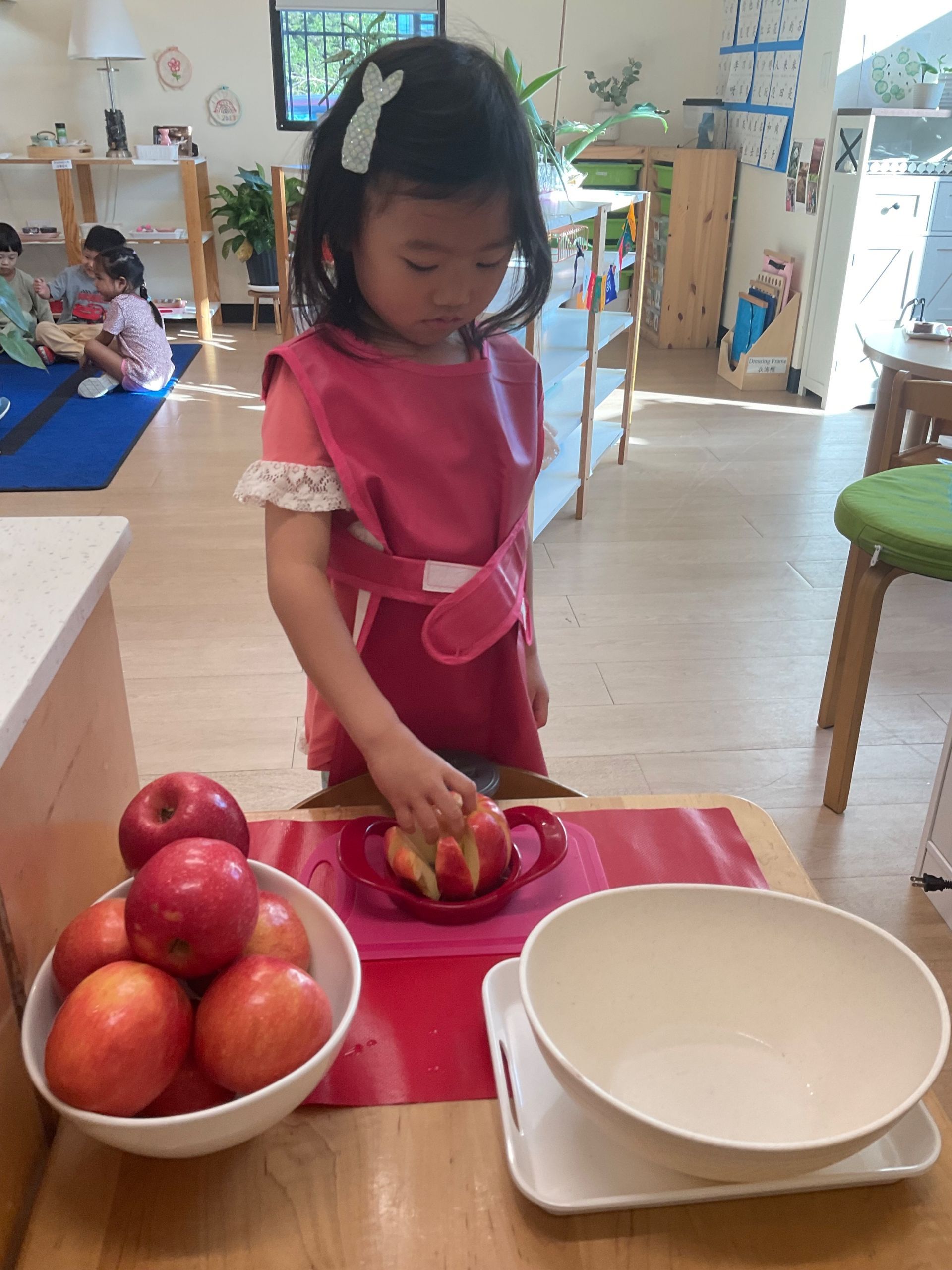
Child in a pink apron arranging fruit on a table in a bright kitchen.
September 28, 2026
Discover how grace and courtesy lessons at LakeCreek Montessori School help children build empathy, social confidence, and deep respect for others.
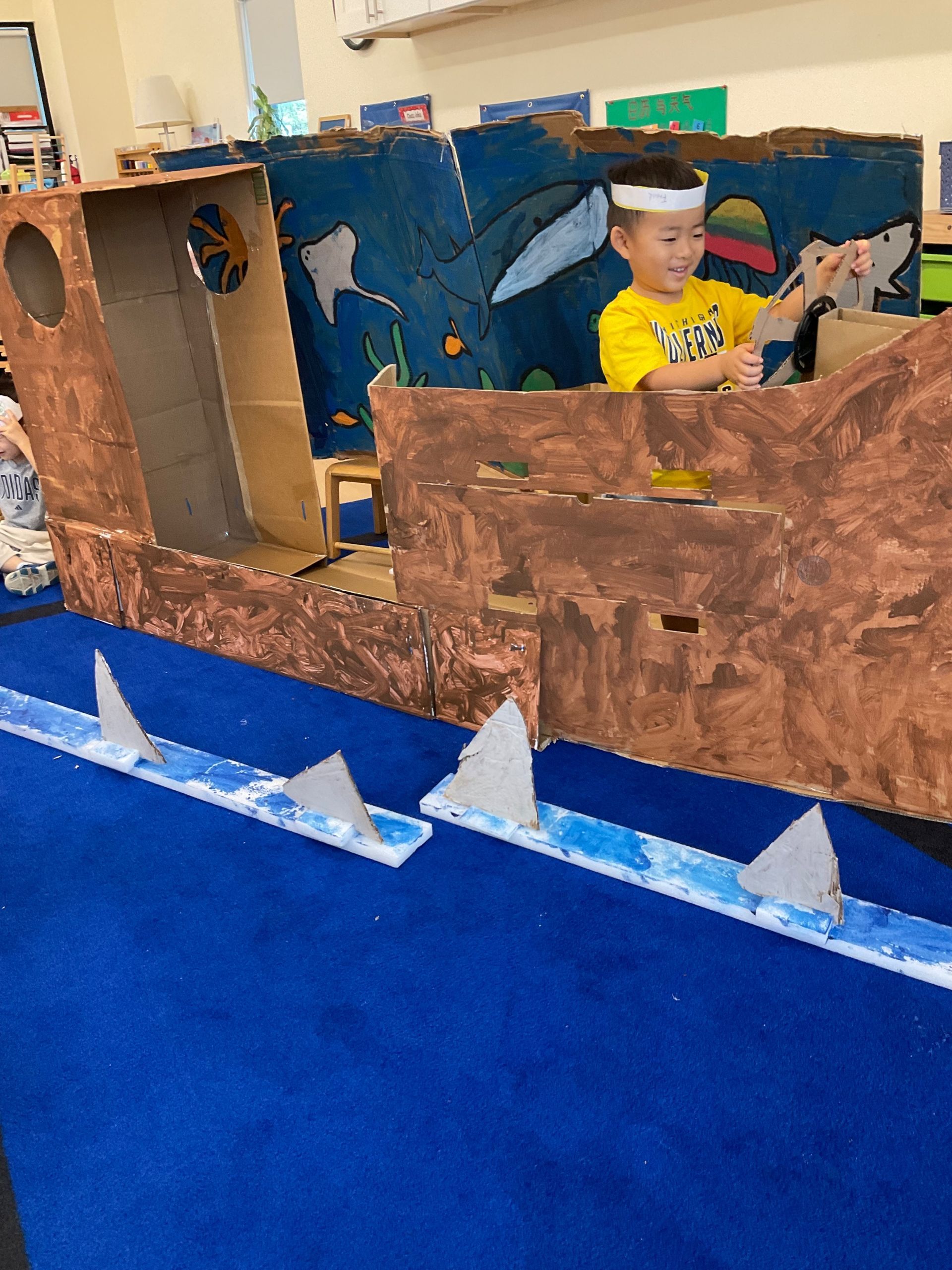
Child in a cardboard pirate ship craft, painted brown and blue, with white waves in a classroom.
September 21, 2026
Step inside a LakeCreek Montessori classroom to discover how uninterrupted work cycles, child-led choices, and trained guides foster deep focus and lifelong independence.
Child playing with colorful toy food on a table beside a brown basket in a bright room
September 14, 2026
Explore how LakeCreek Montessori School builds a peaceful, order-filled community for toddlers and young children, supporting emotional growth and lifelong independence.
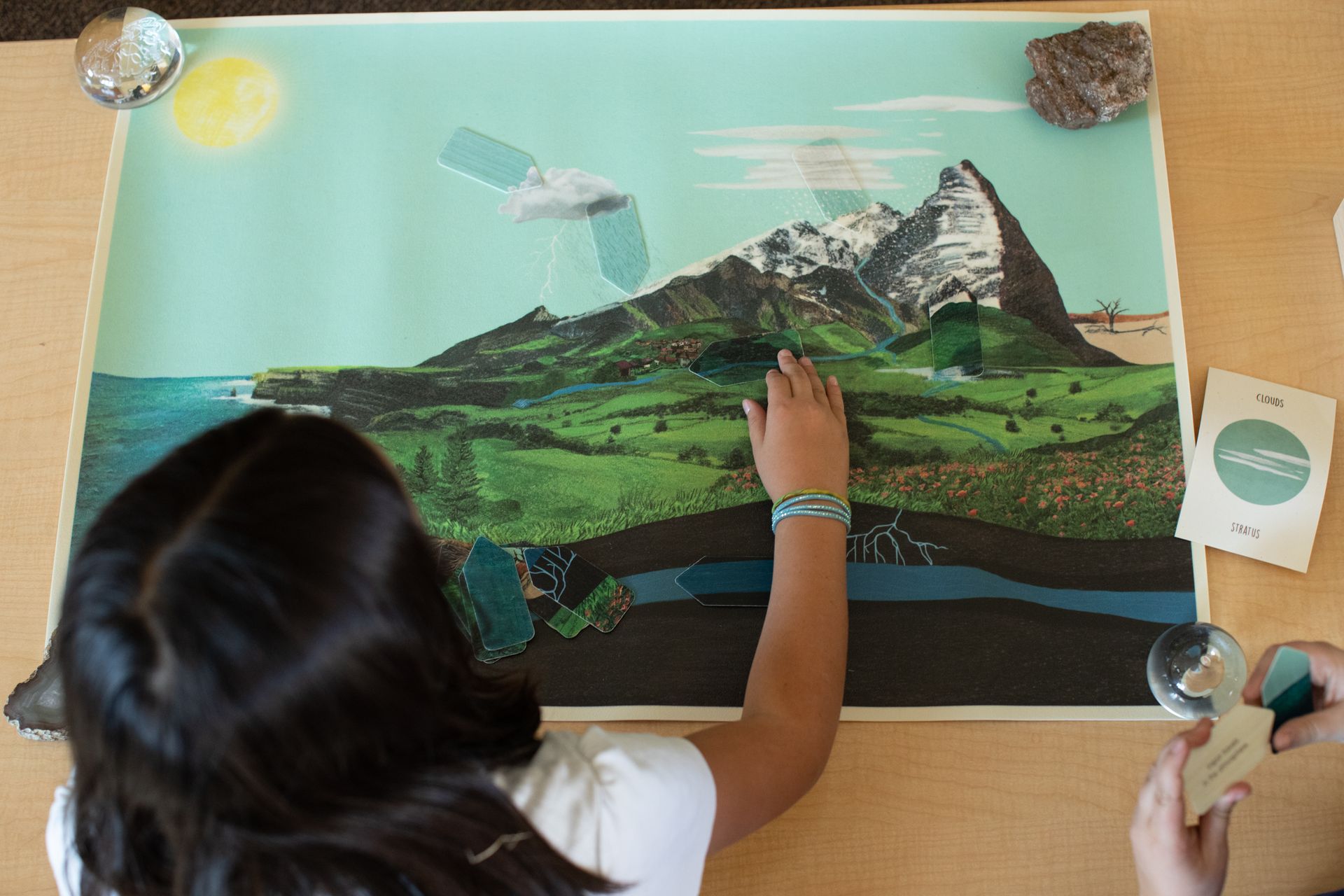
Person arranging a colorful mountain landscape collage on a board with glue and paper cutouts.
September 7, 2026
Discover how authentic Montessori education at LakeCreek Montessori School prepares children for an unpredictable future through independence, strong academics, and executive function.
By LakeCreek Montessori School • June 24, 2026
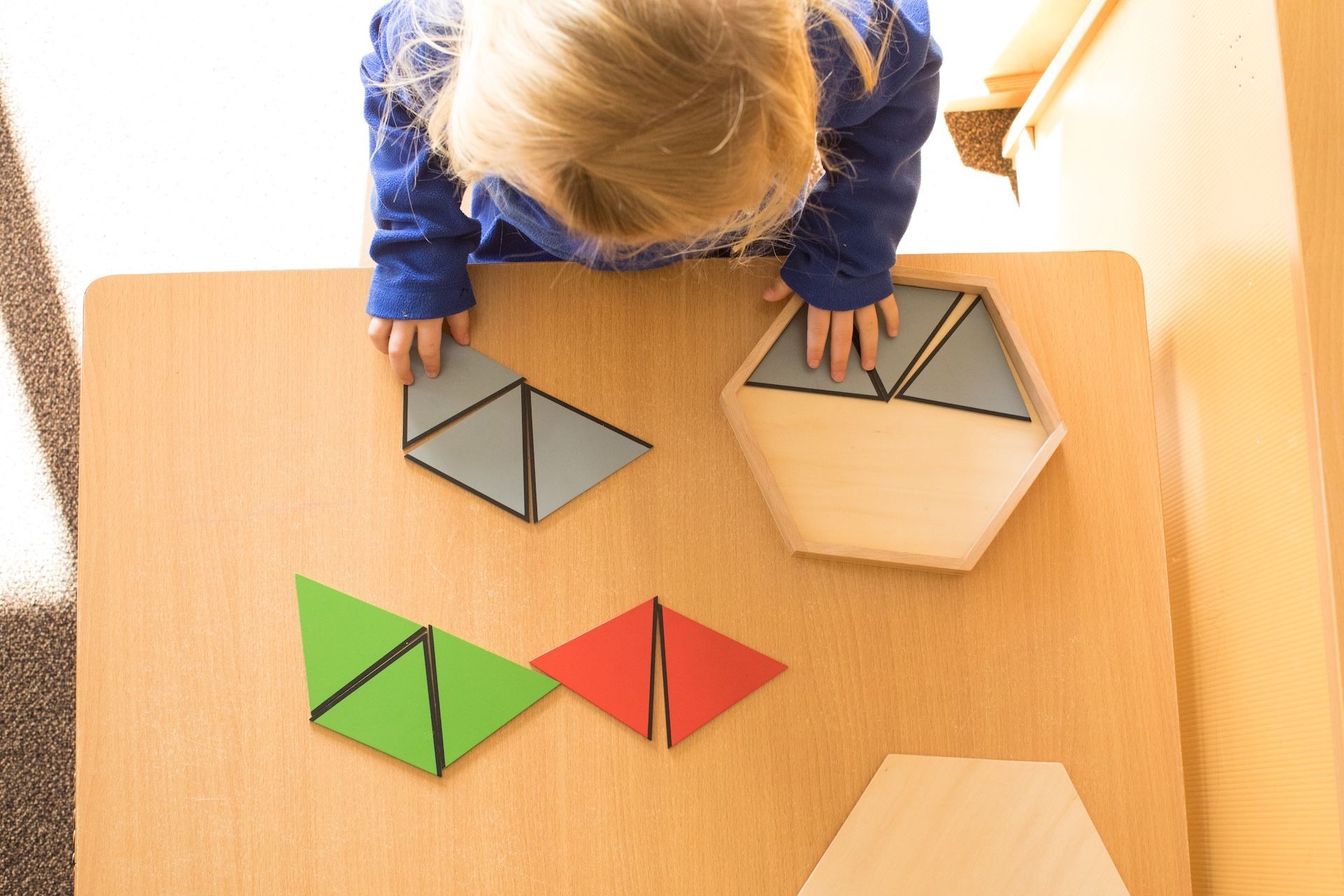
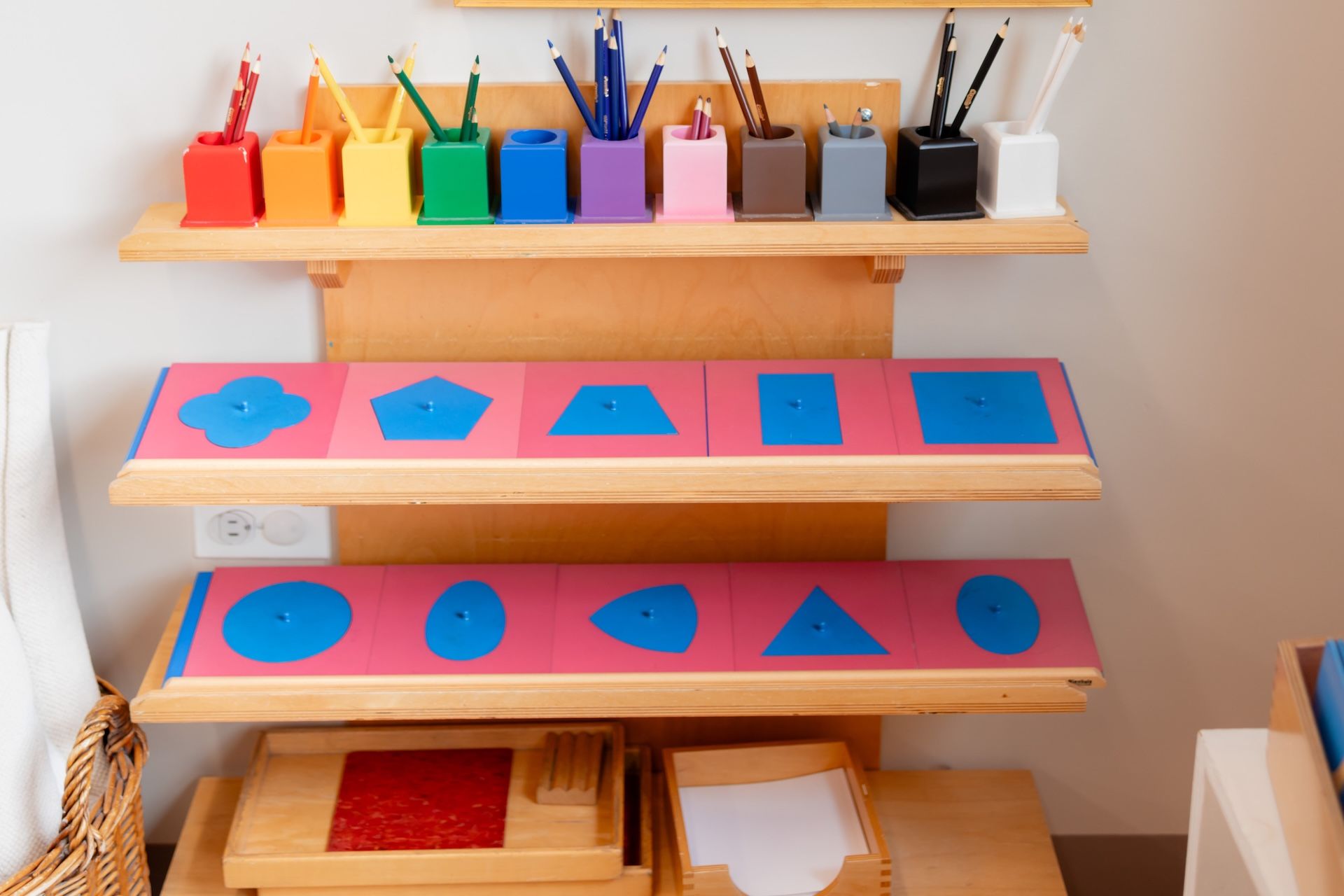
Have you ever watched a child trace the outline of a window with their finger, or carefully line up blocks into a perfectly symmetrical row? They may not have a name for what they're doing, but they are already exploring geometry. Dr. Maria Montessori understood that geometry is not an abstract school subject. It is part of the world children live in from the very beginning. A glance at the typical geometry textbook might suggest otherwise. Formulas, diagrams, and definitions can feel remote and lifeless, something to be memorized and forgotten. But look around for a moment. There is geometry in the angles of a mineral crystal and in the symmetry of a butterfly's wings. There is geometry in the legs of a chair and in the steel girders of a bridge. Children encounter it everywhere! In fact, research suggests that a basic intuitive understanding of geometric concepts may be inborn in human beings. A fascinating study of the Munduruku (an indigenous group living in the Amazon whose language includes very few spatial or geometric terms) found that both adults and children demonstrated an intuitive grasp of basic geometric ideas. This isn't something they were taught. It was already there. Montessori classrooms build on exactly this kind of inborn understanding. From Sensory Experience to Big Ideas In the early childhood years, children work with geometry through their hands. Materials like the Constructive Triangles, the Metal Insets, and the geometric cabinet give children a felt, physical understanding of shape, symmetry, and form before we introduce any formal terminology. Children gather and store these impressions. Their minds are being prepared. As they get older and certainly in the elementary years, children are ready to bring names and reasons to what they already sense. Elementary-aged children don't just want to know what something is called. They also want to know why. Why is this shape called a pentagon? (Spoiler: Its name comes from the Greek word for five: pente.) Geometry becomes a doorway into the history of language, ancient Greece, and the lives of mathematicians like Thales, Pythagoras, and Euclid, who puzzled over the same ideas thousands of years ago. This is the spirit of Cosmic Education when we pull one thread of curiosity to find it unravels into history, language, culture, and mathematics! Geometry, Algebra, and Arithmetic Woven Together One of the things that makes Montessori's approach to geometry so distinctive is that it doesn't stand alone. In the Montessori classroom, geometry is part of a three-part approach to mathematics, interwoven with arithmetic and algebra in ways that make each of them easier to understand. The Binomial Square is a good example. It presents the algebraic expression of (a + b)² = a² + 2ab + b² as a geometric pattern of squares and rectangles that children can actually build and hold. The arithmetic follows the pattern. The pattern confirms the algebra. Each one reinforces the others, and the whole thing is far more memorable than just a formula written on a board. Open-Ended, Creative, and Genuinely Fun Plus, a lot of Montessori geometry work has no single correct answer. We invite children working with the Metal Insets or Constructive Triangles to find as many equivalent figures as they can for a given shape. There may be dozens of ways to approach the same problem. This open-endedness nurtures the creative, analytical thinking that elementary children are hungry for. Plus, this quality of thinking will serve them in every area of life. Compass-and-straightedge constructions are another example. These beautiful, precise drawings challenge children in a way that is both mathematical and artistic. Many children find them deeply satisfying. What This Looks Like at Home You don't have to wait for the classroom to feed your child's geometric curiosity. Point out the shapes in a honeycomb. Notice the angles in a spider's web. Talk about the tiles on the floor or the panes in a window. Ask your child questions. Do you think that could be a triangle? How many sides does it have? These small moments of noticing are the same thing Montessori described when she wrote about preparing the environment to reflect the world children already live in. Geometry is already there. We're simply helping children see it. Come visit us in LakeCreek Montessori School to see how this unfolds in the classroom and to watch children fall in love with one of humanity's oldest ways of understanding the world.
By LakeCreek Montessori School • June 24, 2026
unfold over time. Children begin with a single frame and inset, using three colored pencils: one for tracing the frame, one for tracing the inset, and one for filling in. As their control deepens, subsequent exercises introduce the use of insets only (without frames), multiple overlapping shapes, repeated tracings of a single shape in different positions, and eventually fully free geometric design using any combination of insets, colors, and orientations. One of the most beautiful exercises is graded color. Using a single inset and a single pencil, children fill the shape with vertical lines, moving from darker to lighter (or lighter to darker) by adjusting the pencil pressure. This exercise requires an extraordinary sensitivity of touch, and when children achieve it, the result is genuinely lovely. This work can continue throughout a child’s entire time in the Children’s House. It can be relaxing and meditative, and when older children do it with great refinement, it naturally inspires younger children who observe them. Readiness and Timing Two key preparations precede the metal insets. Children should be able to trace the shapes of the geometry cabinet and the leaf shapes of the leaf cabinet using a stylus, and ideally they should be working with the movable alphabet. Timing matters. If we introduce the work too soon, before the hand is ready, it becomes too great a challenge rather than a satisfying one. The guide’s role is to observe carefully and to offer the presentation at the moment when it will be received with both readiness and joy. The metal insets are a landmark in the child’s journey toward written language. This layered preparation honors both the intelligence of the hand and the unhurried nature of true readiness. We invite you to come see the metal insets and the full breadth of our carefully prepared environment in person. Contact us to schedule a visit here in LakeCreek Montessori School or to learn more about life in our Children’s House.
Show More