Shifting from “Stuff” to the Spirit of the Season

December 5, 2022

All too often the holiday season becomes about “stuff”–presents, decorations, more presents. How do we wean our children away from their focus on getting gifts and instead shift attention to the spirit of togetherness, generosity, peace, and goodwill?


It can be helpful to hold a family meeting and talk about everyone’s feelings about the holidays. We can ask our children about what, besides the gifts, they really like about the holidays. Often memories start to emerge: making gingerbread cookies with Grandma, taking a walk together as a family, ordering take-out Chinese and days-worth of leftovers.


From those memories, you can start brainstorming about what to establish as part of your family holiday tradition, perhaps even exploring new ways to enliven the winter season. Could a family hike followed by hot cocoa be a regular ritual? Coloring and cutting holiday-themed place settings? Decorating cookies to distribute as gifts?


In discussing the holiday, you can also introduce activities that involve giving and service to others. All sorts of studies detail the mental and physical health benefits of selfless service. The term “helper’s high” refers to the chemicals released in our brains when we engage in giving behaviors. Children can be very intrigued by learning about different charities, especially those that are local or important to their families. Part of the process of gift-giving can include choosing a charity and giving a gift in your child’s name or even having your child play a part in delivering the gift. 


Another approach is to focus on giving gifts that are really experiences: a trip to a museum, a weekend family adventure, certificates for favorite excursions, cash and a coupon for an outing to the arcade, a day trip with a friend to the trampoline park. Whatever the experience, the focus is giving the gift of doing something, and ideally doing something together, rather than owning an object. 


Brainstorming about the types of gifts or experiences we share with friends and family during the holiday season helps open our children up to the idea that gifts don’t have to be an item purchased at a store or online. As you explore this idea with your children, you can offer options such as:


  • DYI/Handmade Gifts
  • Care Packages
  • Video Gifts/Electronic Messages
  • Experiential Gifts
  • Gifts of Quality Time
  • Skill Sharing Gifts
  • Donation & Support Gifts
  • Food Gifts


Children can be involved in creating care packages or gift baskets, video collages or audio greetings that can be sent to grandparents, favorite dry goods recipes in mason jars, and coupons for activities or quality time.


We have enough things in our lives. Even if our youngest children aren’t quite ready to give up the idea of getting material presents, we can model both how gifts can take on many different forms and how we can bring more of ourselves to the holiday gift-giving experience.


Likely our children won’t remember a particular toy they unwrapped in 2022, but they will remember what they did with those they love and how they felt while doing it. Perhaps just planning a different kind of giving this year can bring less stress and more joy. What better gift than that?

Child working with the moveable alphabet on a working mat.
October 26, 2026
Learn how Maria Montessori's "sensitive periods" guide your child's natural passion for learning, focus, and independence at LakeCreek Montessori.
Close-up of a silver-topped wooden bell, with more pieces blurred in the background
October 19, 2026
Discover how music is integrated into daily life in LakeCreek Montessori's Toddler and Primary classrooms through the Montessori Bells, singing, and movement.
Two using the smelling bottles at a wooden table in a bright classroom
October 12, 2026
Discover how the Montessori approach develops your child's internal will, self-regulation, and true independence in our Toddler and Primary classrooms at LakeCreek.
Child plays with colorful sensory materials at a table indoors.
October 5, 2026
Discover how the uninterrupted 3-hour work cycle in a Montessori classroom fosters deep focus, independence, and a state of flow for your child.
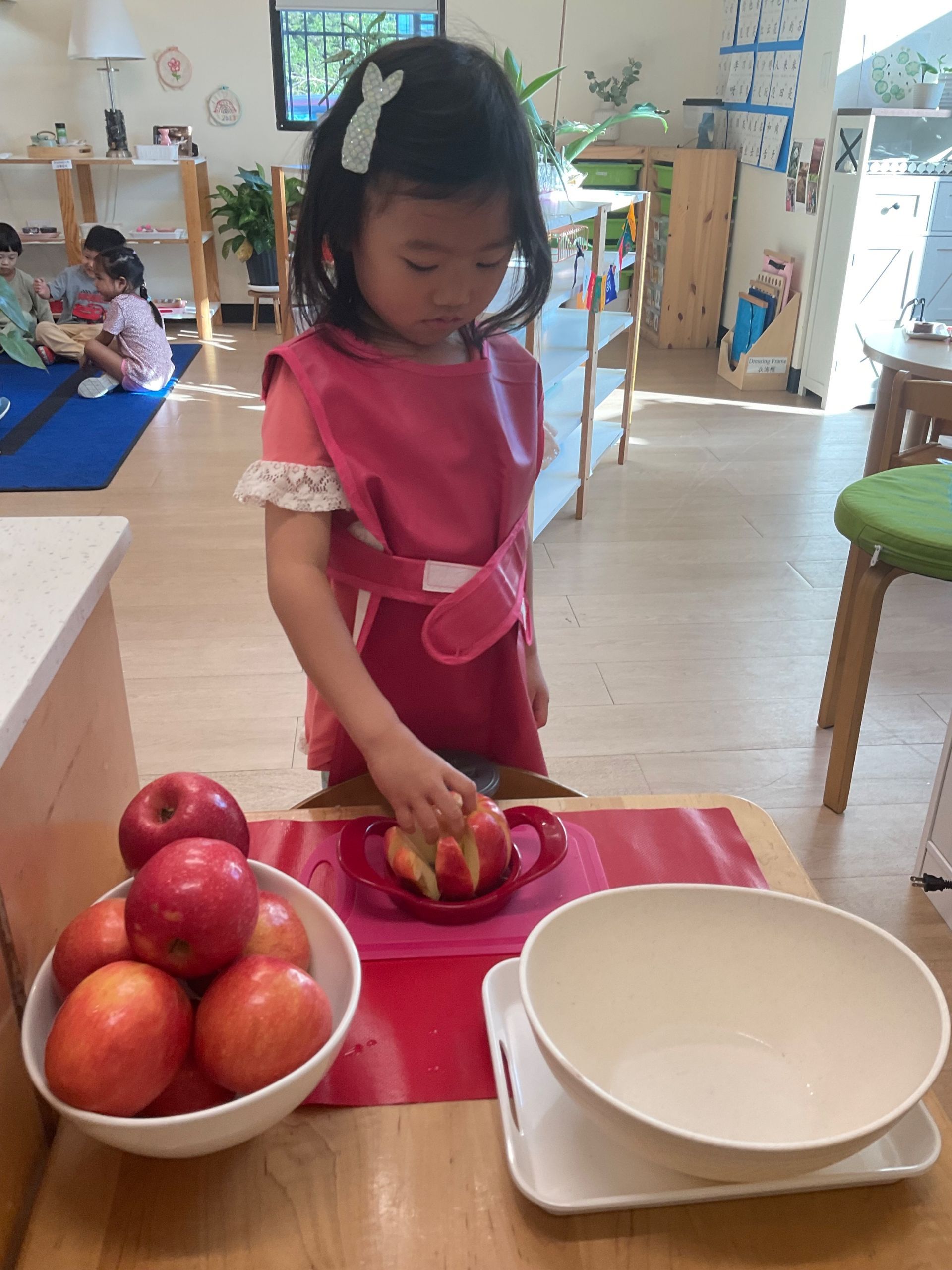
Child in a pink apron arranging fruit on a table in a bright kitchen.
September 28, 2026
Discover how grace and courtesy lessons at LakeCreek Montessori School help children build empathy, social confidence, and deep respect for others.
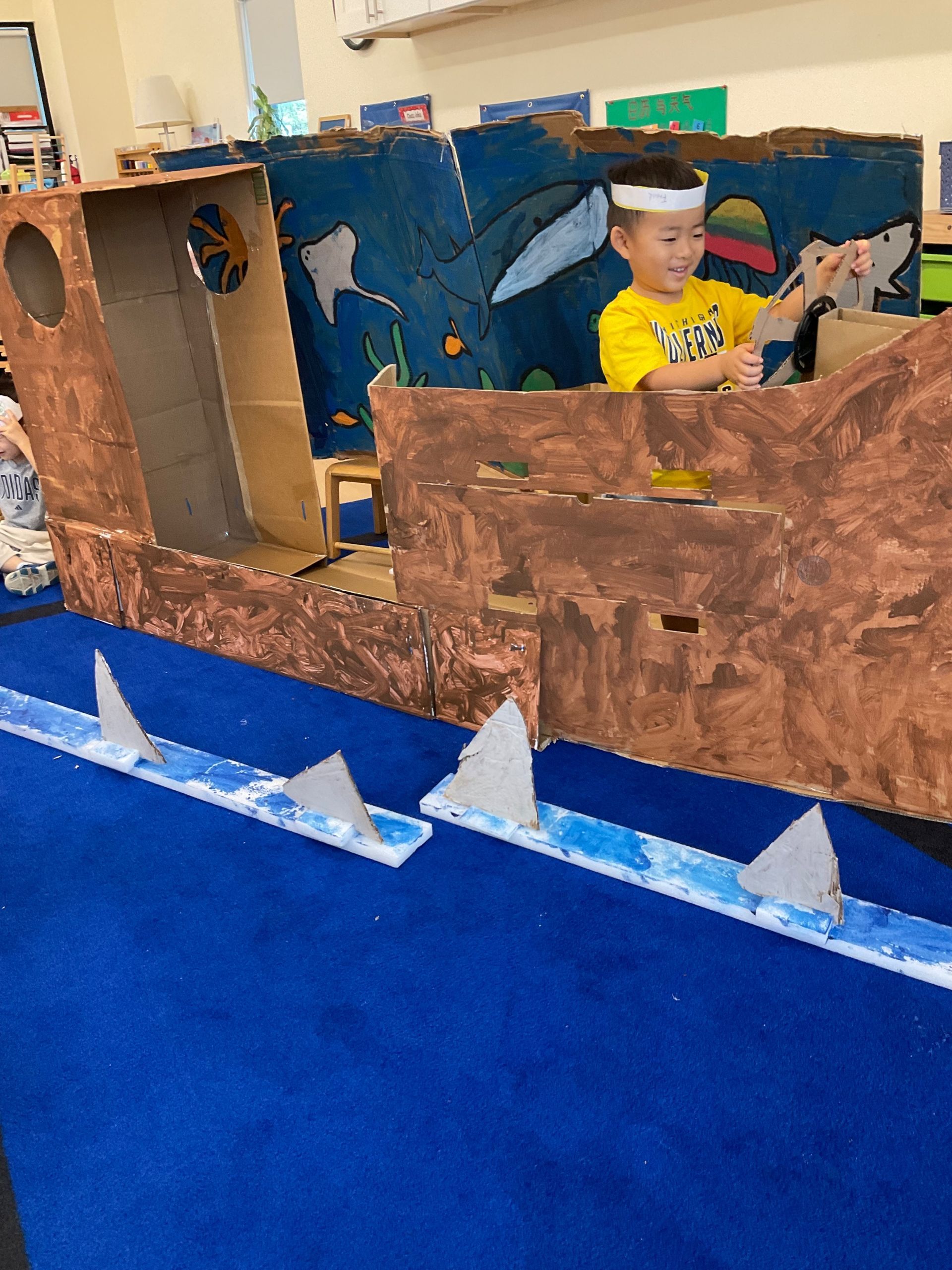
Child in a cardboard pirate ship craft, painted brown and blue, with white waves in a classroom.
September 21, 2026
Step inside a LakeCreek Montessori classroom to discover how uninterrupted work cycles, child-led choices, and trained guides foster deep focus and lifelong independence.
Child playing with colorful toy food on a table beside a brown basket in a bright room
September 14, 2026
Explore how LakeCreek Montessori School builds a peaceful, order-filled community for toddlers and young children, supporting emotional growth and lifelong independence.
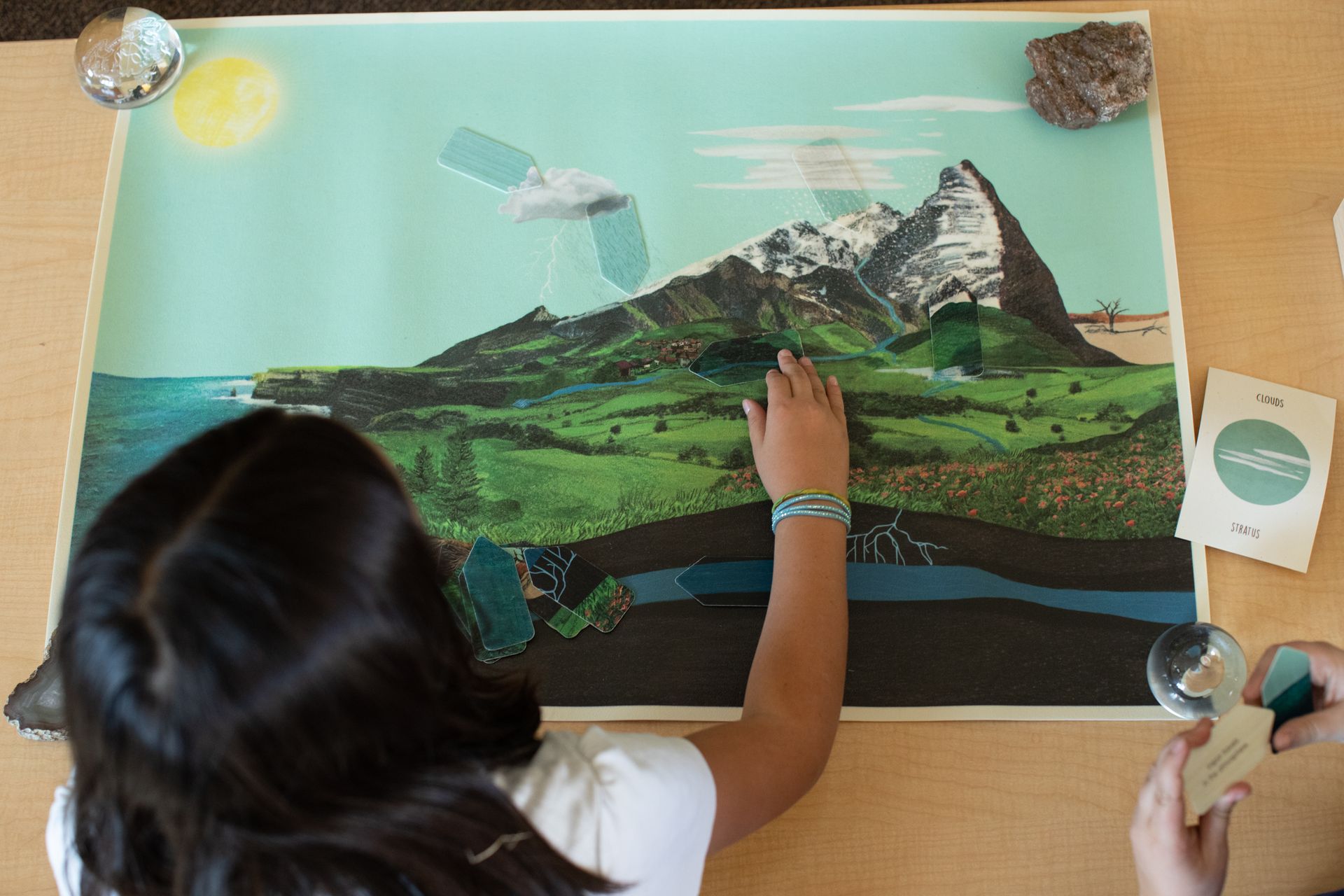
Person arranging a colorful mountain landscape collage on a board with glue and paper cutouts.
September 7, 2026
Discover how authentic Montessori education at LakeCreek Montessori School prepares children for an unpredictable future through independence, strong academics, and executive function.
By LakeCreek Montessori School • June 24, 2026
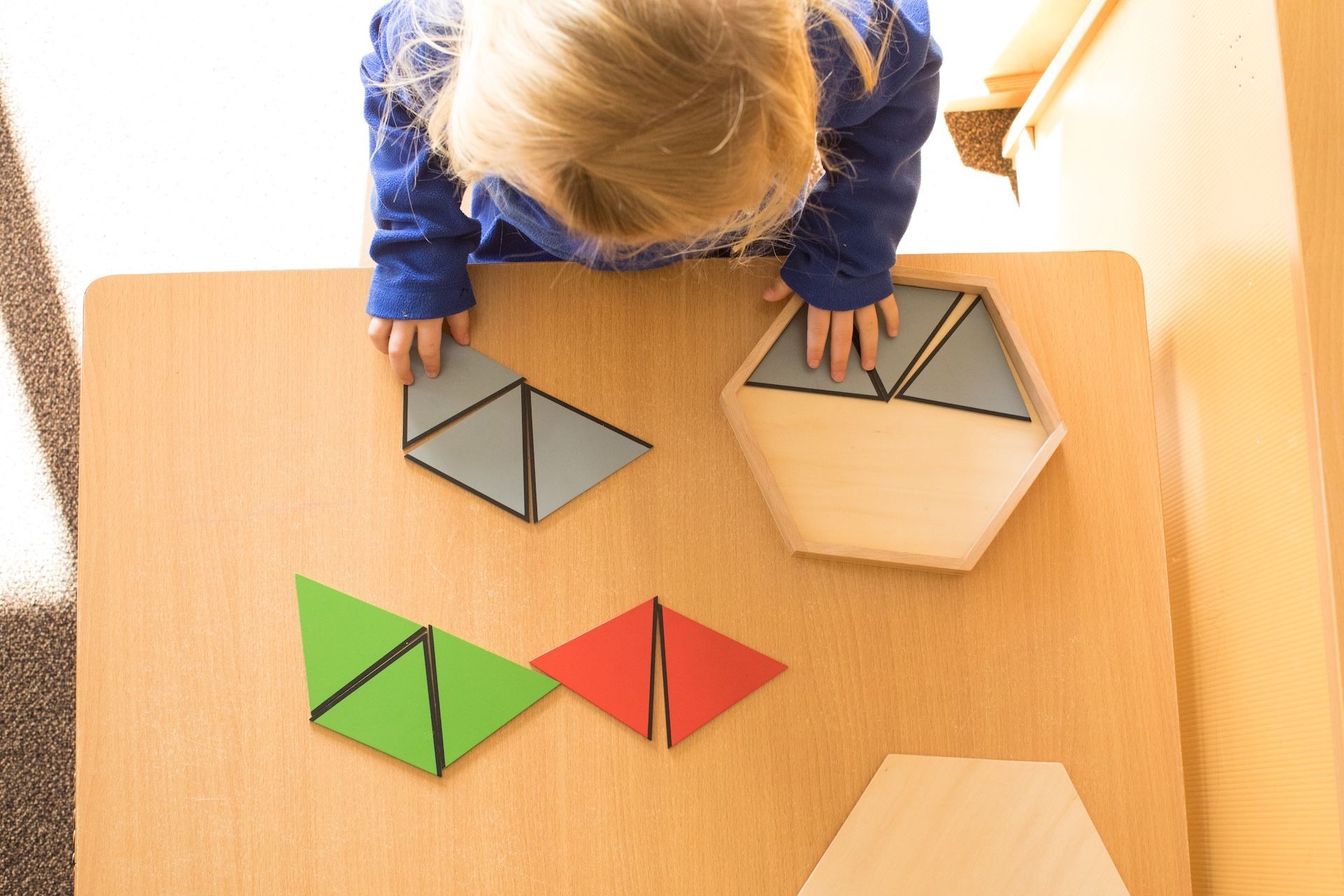
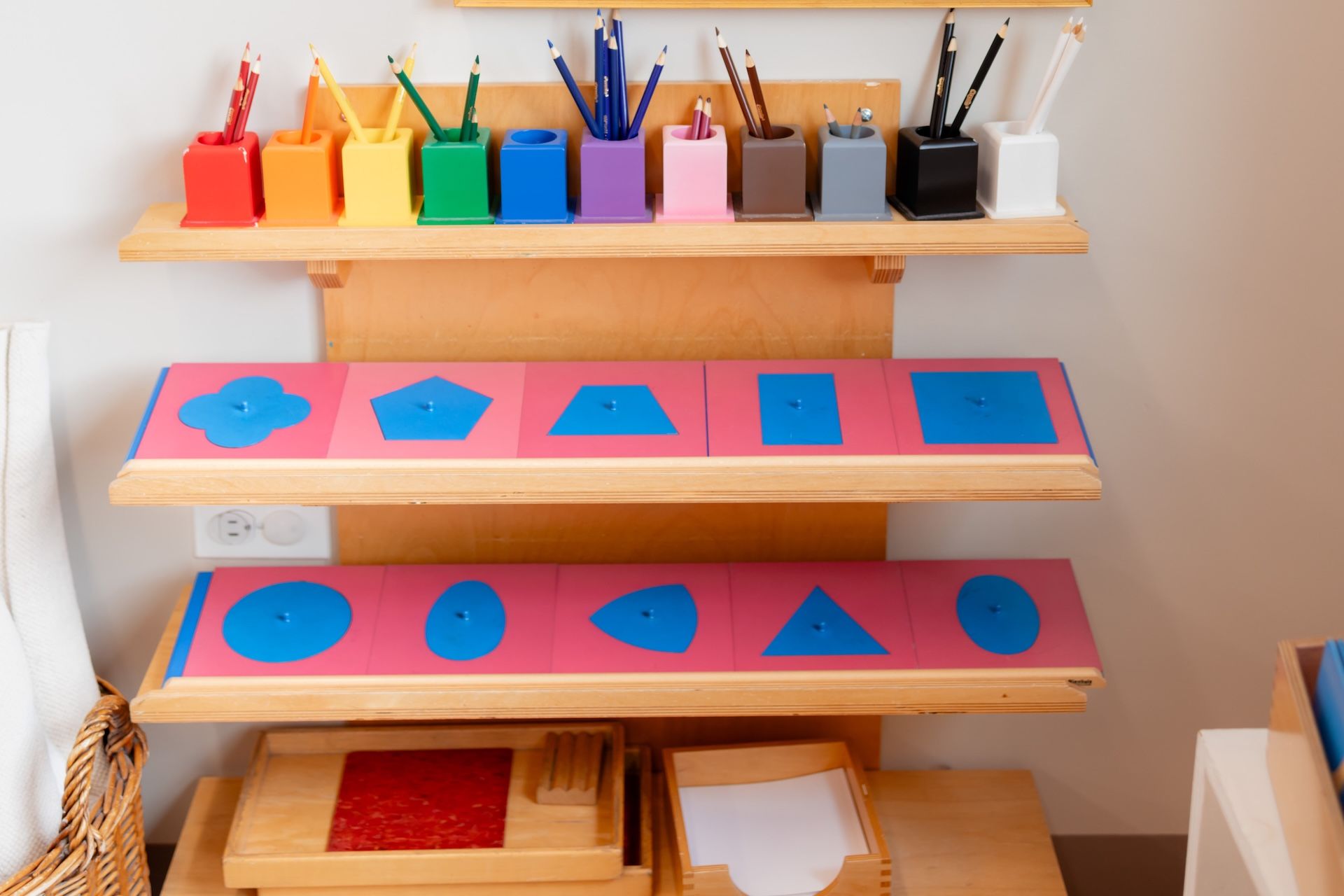
Have you ever watched a child trace the outline of a window with their finger, or carefully line up blocks into a perfectly symmetrical row? They may not have a name for what they're doing, but they are already exploring geometry. Dr. Maria Montessori understood that geometry is not an abstract school subject. It is part of the world children live in from the very beginning. A glance at the typical geometry textbook might suggest otherwise. Formulas, diagrams, and definitions can feel remote and lifeless, something to be memorized and forgotten. But look around for a moment. There is geometry in the angles of a mineral crystal and in the symmetry of a butterfly's wings. There is geometry in the legs of a chair and in the steel girders of a bridge. Children encounter it everywhere! In fact, research suggests that a basic intuitive understanding of geometric concepts may be inborn in human beings. A fascinating study of the Munduruku (an indigenous group living in the Amazon whose language includes very few spatial or geometric terms) found that both adults and children demonstrated an intuitive grasp of basic geometric ideas. This isn't something they were taught. It was already there. Montessori classrooms build on exactly this kind of inborn understanding. From Sensory Experience to Big Ideas In the early childhood years, children work with geometry through their hands. Materials like the Constructive Triangles, the Metal Insets, and the geometric cabinet give children a felt, physical understanding of shape, symmetry, and form before we introduce any formal terminology. Children gather and store these impressions. Their minds are being prepared. As they get older and certainly in the elementary years, children are ready to bring names and reasons to what they already sense. Elementary-aged children don't just want to know what something is called. They also want to know why. Why is this shape called a pentagon? (Spoiler: Its name comes from the Greek word for five: pente.) Geometry becomes a doorway into the history of language, ancient Greece, and the lives of mathematicians like Thales, Pythagoras, and Euclid, who puzzled over the same ideas thousands of years ago. This is the spirit of Cosmic Education when we pull one thread of curiosity to find it unravels into history, language, culture, and mathematics! Geometry, Algebra, and Arithmetic Woven Together One of the things that makes Montessori's approach to geometry so distinctive is that it doesn't stand alone. In the Montessori classroom, geometry is part of a three-part approach to mathematics, interwoven with arithmetic and algebra in ways that make each of them easier to understand. The Binomial Square is a good example. It presents the algebraic expression of (a + b)² = a² + 2ab + b² as a geometric pattern of squares and rectangles that children can actually build and hold. The arithmetic follows the pattern. The pattern confirms the algebra. Each one reinforces the others, and the whole thing is far more memorable than just a formula written on a board. Open-Ended, Creative, and Genuinely Fun Plus, a lot of Montessori geometry work has no single correct answer. We invite children working with the Metal Insets or Constructive Triangles to find as many equivalent figures as they can for a given shape. There may be dozens of ways to approach the same problem. This open-endedness nurtures the creative, analytical thinking that elementary children are hungry for. Plus, this quality of thinking will serve them in every area of life. Compass-and-straightedge constructions are another example. These beautiful, precise drawings challenge children in a way that is both mathematical and artistic. Many children find them deeply satisfying. What This Looks Like at Home You don't have to wait for the classroom to feed your child's geometric curiosity. Point out the shapes in a honeycomb. Notice the angles in a spider's web. Talk about the tiles on the floor or the panes in a window. Ask your child questions. Do you think that could be a triangle? How many sides does it have? These small moments of noticing are the same thing Montessori described when she wrote about preparing the environment to reflect the world children already live in. Geometry is already there. We're simply helping children see it. Come visit us in LakeCreek Montessori School to see how this unfolds in the classroom and to watch children fall in love with one of humanity's oldest ways of understanding the world.
By LakeCreek Montessori School • June 24, 2026
unfold over time. Children begin with a single frame and inset, using three colored pencils: one for tracing the frame, one for tracing the inset, and one for filling in. As their control deepens, subsequent exercises introduce the use of insets only (without frames), multiple overlapping shapes, repeated tracings of a single shape in different positions, and eventually fully free geometric design using any combination of insets, colors, and orientations. One of the most beautiful exercises is graded color. Using a single inset and a single pencil, children fill the shape with vertical lines, moving from darker to lighter (or lighter to darker) by adjusting the pencil pressure. This exercise requires an extraordinary sensitivity of touch, and when children achieve it, the result is genuinely lovely. This work can continue throughout a child’s entire time in the Children’s House. It can be relaxing and meditative, and when older children do it with great refinement, it naturally inspires younger children who observe them. Readiness and Timing Two key preparations precede the metal insets. Children should be able to trace the shapes of the geometry cabinet and the leaf shapes of the leaf cabinet using a stylus, and ideally they should be working with the movable alphabet. Timing matters. If we introduce the work too soon, before the hand is ready, it becomes too great a challenge rather than a satisfying one. The guide’s role is to observe carefully and to offer the presentation at the moment when it will be received with both readiness and joy. The metal insets are a landmark in the child’s journey toward written language. This layered preparation honors both the intelligence of the hand and the unhurried nature of true readiness. We invite you to come see the metal insets and the full breadth of our carefully prepared environment in person. Contact us to schedule a visit here in LakeCreek Montessori School or to learn more about life in our Children’s House.
Show More