Materials Spotlight: The Grammar Boxes

LakeCreek Montessori School • August 27, 2024

One of the best parts of a Montessori education is that learning is so much fun! We provide hands-on activities and experiences that engage children’s hearts and minds and help them grasp abstract concepts and master complicated skills.


For example, when we introduce grammar in elementary, we use the Grammar Boxes, a set of materials that involve reading, interpretation, acting, art, movement, pattern-finding, and even poetry. The result is that grammar becomes an experiential and joyful process that children get to play with and even embody. Grammar work in Montessori elementary classrooms is also a group activity, which our gregarious elementary-aged children absolutely love.


The Materials


The Grammar Boxes comprise an array of colorful materials that easily take up a whole shelf in the classroom. Like so many Montessori materials, they use color coding to help children establish stronger neural pathways to identify parts of speech and their function in sentences.


Each of the eight grammar boxes has one large compartment that holds cards with sets of phrases and sentences, as well as smaller compartments for one-word cards. The cards are different colors for each part of speech: article (tan), noun (black), adjective (brown), verb (red), preposition (green), adverb (orange), pronoun (purple), conjunction (pink), interjection (yellow).


Children experience the name, symbol, and function of each part of speech in a multi-sensorial way, maximizing their opportunity to acquire real and deep understanding.


The Activity


We start with little games to introduce the part of speech. For example, we provide commands, like skip, run, hide, hum, and so on, to experience the role the verb plays. Next, we select the grammar box and filler box to match the part of speech. Children fill the grammar box with the various cards, and then they choose one of the sentence cards and read the sentence. Using the one-word cards, they build the sentence by looking through the smaller compartments in the grammar box to find each word.


In the preposition grammar box, one of the sentences states, “Lay the pen with the pencil.” When children look for each of the words, they will find that “pen” and “pencil” are on black cards because they are nouns. “Lay” is on a red card because it is a verb. “The” is on a tan card because it is an article. The new type of word – “with” – is a preposition. Children build the sentence and then act it out.


The next sentence on the card is exactly the same except for one variation. “With” changes to “behind” so the sentence reads “Lay the pen behind the pencil.” So children keep the constructed sentence but just change the one card. They act out the sentence again, experiencing how changing the preposition changes the sentence in a certain way. The final sentence on the card reads “Lay the pen beside the pencil.” This acting out and playing around with what happens when one-word changes provides a sensorial experience of the parts of speech.


We also share key phrases that highlight the function of the part of speech. For example, when working with pronouns, we’ll state, “This kind of word stands in place of a noun.” The children come to appreciate how words do important work just like they do. As a result, they experience an inspired interest in the functions performed by different words.


Continued Exploration


Once children have mastered this first step, the Grammar Box materials offer multiple forms of follow-up to promote deeper understanding.


Symbolizing

We link each part of speech with a color-coded symbol. For example, nouns are represented by black triangles and verbs by red circles. Children love to “symbolize” the grammar box sentences, as well as sentences they have written or even sentences from books. This practice is essentially an early form of sentence diagramming and children begin to notice visual patterns in the structure of sentences.


Quizzing

We can also play a little game to quiz children on the parts of speech and their functions. One form of this is to cover all the smaller, labeled compartments with color-coded paper. We might prompt the children, “What is the name of the word that told you the action?” They’ll call out “verb!” And we reveal (or they will check) the answer by removing the red slip.


Transposing

When we move words around in a sentence or phrase, the meaning may remain essentially the same, change dramatically, or be lost entirely! So, with the grammar box cards, we play around with shifting the order of the words in the constructed sentences and phrases. This highlights the importance of word order in our language and also opens up some creative thinking about poetic phrases (which often enlivens the imagination of young poets!).

Reading Commands

Children also love using the command cards that accompany each grammar box. These cards encourage dramatic interpretation and build reading comprehension. Children interpret nuances as they explore gradations in vocabulary and eventually even how subtle shifts in vocabulary can impact meaning or interpretation.


Extensions


After children learn key grammar language and concepts via the Grammar Boxes, we initiate a deeper study into classifications within each part of speech. For example, a study of the verb moves to an examination of the differences between action and linking verbs, a study of voice and mood, and an exploration of the tenses.


Extension work also includes more complex and detailed written work, a study of synonyms, further exploration of ideas presented in the introductory work, and research related to the parts of speech and the history of our language.


Elementary children love the extraordinary, the peculiar, and the unusual. Carefully selected words in the Grammar Boxes help spark this fascination, drawing the children into a study of the science of their language.


Although work with the Grammar Boxes helps children learn about and understand the functions of the different parts of speech, the lessons also demand a great deal of active and physical expression and thus support children’s powers of expression.


This is what “reading comprehension” really is. We can observe the quality and sophistication of children’s understanding by the precision with which each child carries out the actions required by any particular grammar box text.


The Importance of Grammar


A good grasp of grammar empowers us to communicate and interpret others’ communication with greater clarity and understanding. Thus, our goal is to help each child wield their language with accuracy and power. Grammar work in elementary invites a rich vocabulary and fosters an expansive use of our language in all of its expressions.


Grammar work is an exciting, fun, and intellectually stimulating activity in Montessori classrooms. Schedule a tour today to experience this in person!

Child using the folding cloths on a table in a classroom setting
November 2, 2026
Discover practical Montessori-inspired ways to involve your child in holiday preparations while keeping your home calm, grounded, and joyful this season.
Child working with the moveable alphabet on a working mat.
October 26, 2026
Learn how Maria Montessori's "sensitive periods" guide your child's natural passion for learning, focus, and independence at LakeCreek Montessori.
Close-up of a silver-topped wooden bell, with more pieces blurred in the background
October 19, 2026
Discover how music is integrated into daily life in LakeCreek Montessori's Toddler and Primary classrooms through the Montessori Bells, singing, and movement.
Two using the smelling bottles at a wooden table in a bright classroom
October 12, 2026
Discover how the Montessori approach develops your child's internal will, self-regulation, and true independence in our Toddler and Primary classrooms at LakeCreek.
Child plays with colorful sensory materials at a table indoors.
October 5, 2026
Discover how the uninterrupted 3-hour work cycle in a Montessori classroom fosters deep focus, independence, and a state of flow for your child.
Child in a pink apron arranging fruit on a table in a bright kitchen.
September 28, 2026
Discover how grace and courtesy lessons at LakeCreek Montessori School help children build empathy, social confidence, and deep respect for others.
Child in a cardboard pirate ship craft, painted brown and blue, with white waves in a classroom.
September 21, 2026
Step inside a LakeCreek Montessori classroom to discover how uninterrupted work cycles, child-led choices, and trained guides foster deep focus and lifelong independence.
Child playing with colorful toy food on a table beside a brown basket in a bright room
September 14, 2026
Explore how LakeCreek Montessori School builds a peaceful, order-filled community for toddlers and young children, supporting emotional growth and lifelong independence.
Person arranging a colorful mountain landscape collage on a board with glue and paper cutouts.
September 7, 2026
Discover how authentic Montessori education at LakeCreek Montessori School prepares children for an unpredictable future through independence, strong academics, and executive function.
By LakeCreek Montessori School • June 24, 2026
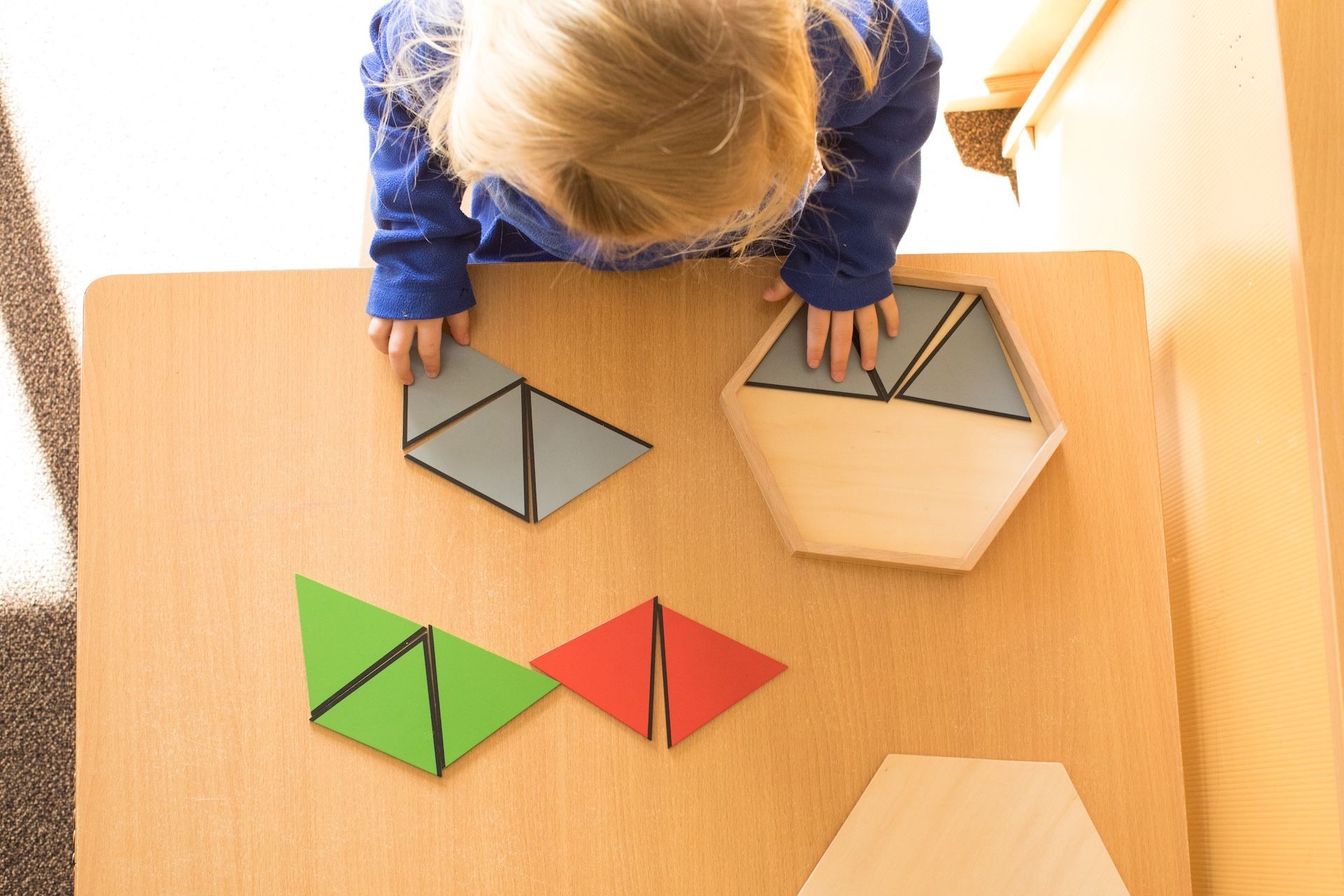
Have you ever watched a child trace the outline of a window with their finger, or carefully line up blocks into a perfectly symmetrical row? They may not have a name for what they're doing, but they are already exploring geometry. Dr. Maria Montessori understood that geometry is not an abstract school subject. It is part of the world children live in from the very beginning. A glance at the typical geometry textbook might suggest otherwise. Formulas, diagrams, and definitions can feel remote and lifeless, something to be memorized and forgotten. But look around for a moment. There is geometry in the angles of a mineral crystal and in the symmetry of a butterfly's wings. There is geometry in the legs of a chair and in the steel girders of a bridge. Children encounter it everywhere! In fact, research suggests that a basic intuitive understanding of geometric concepts may be inborn in human beings. A fascinating study of the Munduruku (an indigenous group living in the Amazon whose language includes very few spatial or geometric terms) found that both adults and children demonstrated an intuitive grasp of basic geometric ideas. This isn't something they were taught. It was already there. Montessori classrooms build on exactly this kind of inborn understanding. From Sensory Experience to Big Ideas In the early childhood years, children work with geometry through their hands. Materials like the Constructive Triangles, the Metal Insets, and the geometric cabinet give children a felt, physical understanding of shape, symmetry, and form before we introduce any formal terminology. Children gather and store these impressions. Their minds are being prepared. As they get older and certainly in the elementary years, children are ready to bring names and reasons to what they already sense. Elementary-aged children don't just want to know what something is called. They also want to know why. Why is this shape called a pentagon? (Spoiler: Its name comes from the Greek word for five: pente.) Geometry becomes a doorway into the history of language, ancient Greece, and the lives of mathematicians like Thales, Pythagoras, and Euclid, who puzzled over the same ideas thousands of years ago. This is the spirit of Cosmic Education when we pull one thread of curiosity to find it unravels into history, language, culture, and mathematics! Geometry, Algebra, and Arithmetic Woven Together One of the things that makes Montessori's approach to geometry so distinctive is that it doesn't stand alone. In the Montessori classroom, geometry is part of a three-part approach to mathematics, interwoven with arithmetic and algebra in ways that make each of them easier to understand. The Binomial Square is a good example. It presents the algebraic expression of (a + b)² = a² + 2ab + b² as a geometric pattern of squares and rectangles that children can actually build and hold. The arithmetic follows the pattern. The pattern confirms the algebra. Each one reinforces the others, and the whole thing is far more memorable than just a formula written on a board. Open-Ended, Creative, and Genuinely Fun Plus, a lot of Montessori geometry work has no single correct answer. We invite children working with the Metal Insets or Constructive Triangles to find as many equivalent figures as they can for a given shape. There may be dozens of ways to approach the same problem. This open-endedness nurtures the creative, analytical thinking that elementary children are hungry for. Plus, this quality of thinking will serve them in every area of life. Compass-and-straightedge constructions are another example. These beautiful, precise drawings challenge children in a way that is both mathematical and artistic. Many children find them deeply satisfying. What This Looks Like at Home You don't have to wait for the classroom to feed your child's geometric curiosity. Point out the shapes in a honeycomb. Notice the angles in a spider's web. Talk about the tiles on the floor or the panes in a window. Ask your child questions. Do you think that could be a triangle? How many sides does it have? These small moments of noticing are the same thing Montessori described when she wrote about preparing the environment to reflect the world children already live in. Geometry is already there. We're simply helping children see it. Come visit us in LakeCreek Montessori School to see how this unfolds in the classroom and to watch children fall in love with one of humanity's oldest ways of understanding the world.
Show More